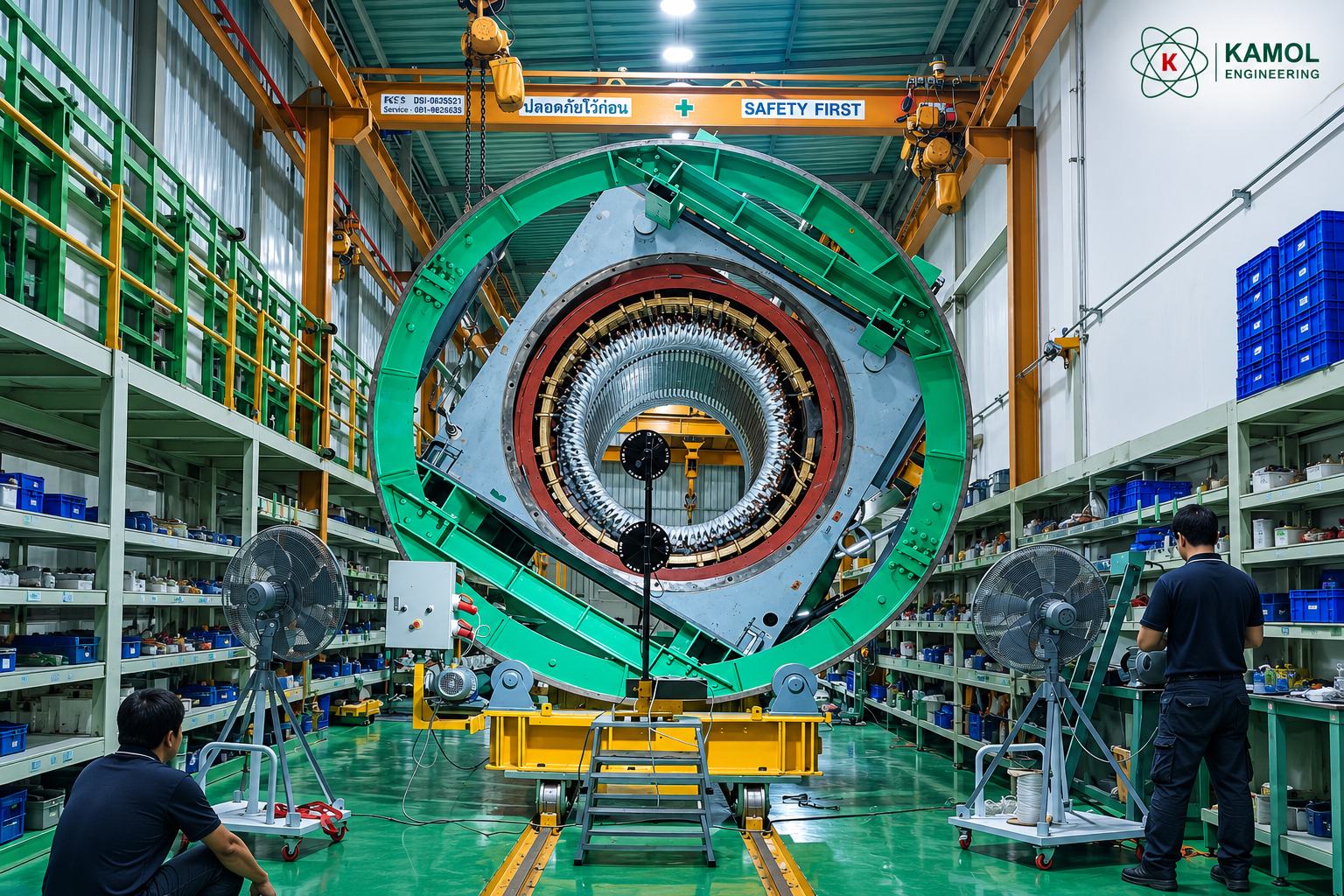
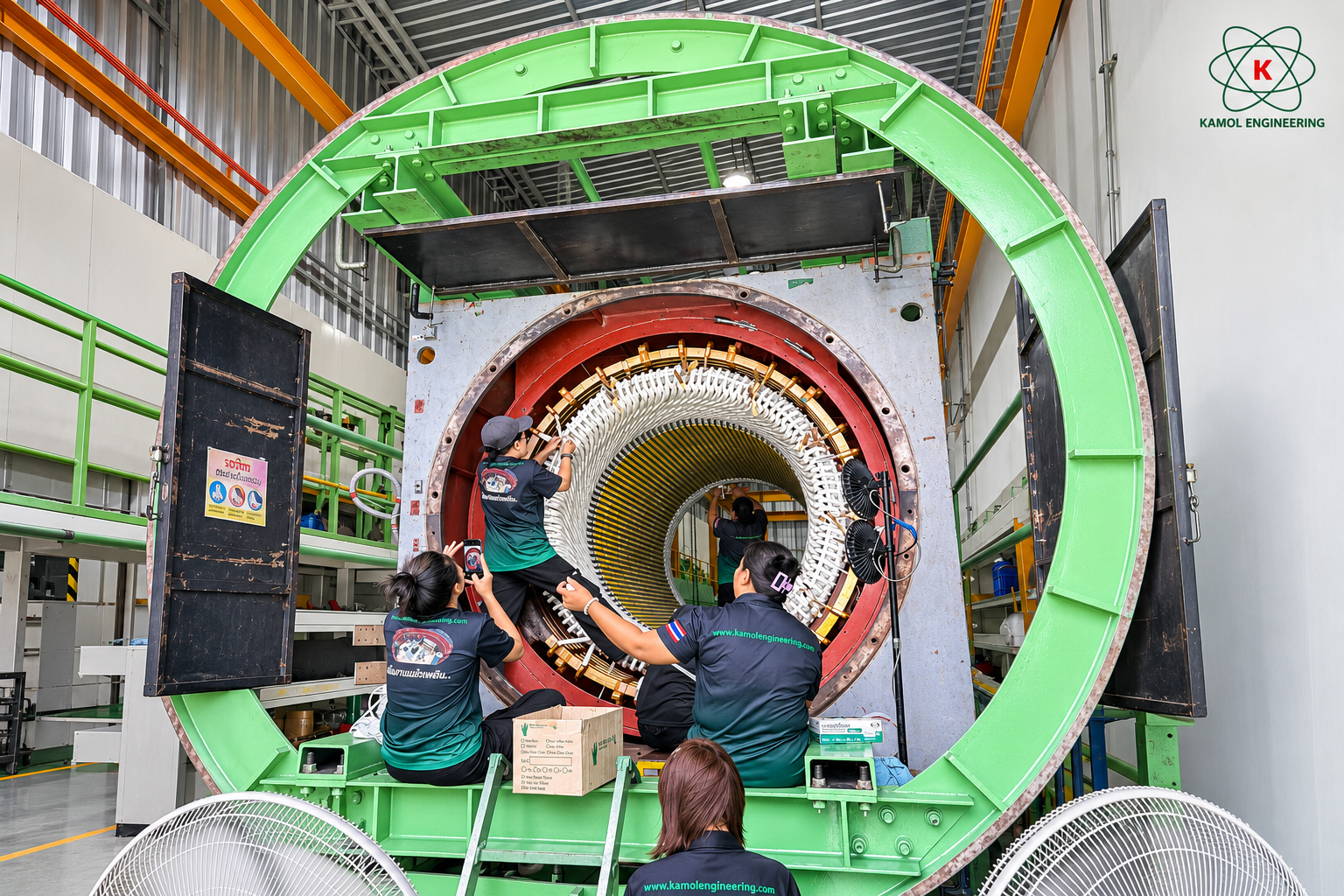
A Practical Approach to Large Generator Winding Work
On a large generator, reaching the next section of the stator winding can be a job in itself.
The technicians may have completed work on one group of coils, but the next section is now at an awkward angle. If the stator cannot be repositioned conveniently, changing the working position may involve additional handling equipment, preparation and coordination.
For a heavy stator, arranging another crane-assisted lift is not a small task. The lift needs to be planned, the movement area controlled, and the component supported before work can continue.
A roller-supported stator rotation fixture offers a different way to organize that part of the job.
In the workshop arrangement described by Kamol Engineering, the stator is supported by a rotating fixture and its position can be adjusted using a remote control.
Rather than arranging another crane lift for every change of working angle, the team can reposition the supported stator and continue work once it is safely stopped and secured.
The value is practical: fewer repeated handling steps, better access to successive winding locations and a more manageable work sequence.
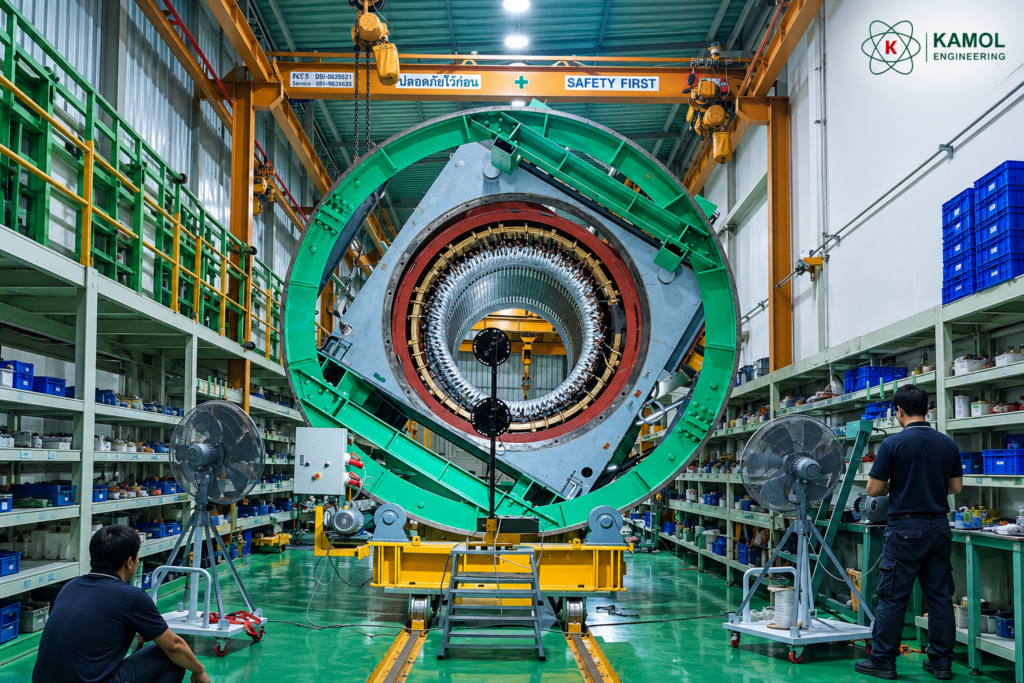
Why Repositioning a Large Stator Can Slow Down Winding Work
A generator stator contains winding sections arranged around the inner circumference of its core. Depending on the repair scope, technicians may need to work at several different angular positions.
Some areas can be reached comfortably from the current setup. Others may require changes in work-platform access or the position of the component.
When repositioning involves another crane-assisted operation, the process can include preparing lifting arrangements, checking clearances, moving the component and securing it again before work resumes.
Those steps are necessary when lifting is required. However, repeating them many times can interrupt the flow of work.
The question is whether every change of working position really needs another lift.
For a stator already installed in a suitable rotation fixture, supported angular repositioning may provide an alternative.
How a Roller-Supported Stator Rotation Fixture Changes the Workflow
Supporting the Stator While Its Position Is Adjusted
The purpose of a stator rotation fixture is to support the component while allowing its angular position to be changed in a controlled way.
The workshop arrangement described for this generator uses rollers and a supporting structure to help reposition the stator.
However, the exact roller layout, drive mechanism, load capacity and operating limits must be established from the actual fixture design. They cannot be determined from the generator’s electrical rating alone.
The fixture must be suitable for the stator’s actual mass, geometry, support requirements and intended movement.
Remote Control for Positioning
According to the information supplied for this workshop arrangement, the operator can command stator rotation using a remote control.
This makes it possible to change the stator’s working angle without arranging a separate crane lift for every repositioning step during the supported-work phase.
For technicians, this may mean less interruption between successive winding locations.
It does not mean the stator can be moved without precautions. Remote control changes how movement is commanded; it does not remove the hazards associated with moving heavy equipment.
Reposition First, Then Resume Hands-On Work
Stator movement and hands-on winding work should be treated as separate activities.
During rotation, personnel must remain clear of the relevant movement zones, pinch points and other equipment-specific hazards.
Once the required position is reached, the stator must be stopped and appropriately secured under the approved operating procedure before work resumes in areas exposed to movement hazards.
This approach makes controlled positioning part of the work plan rather than an improvised adjustment.
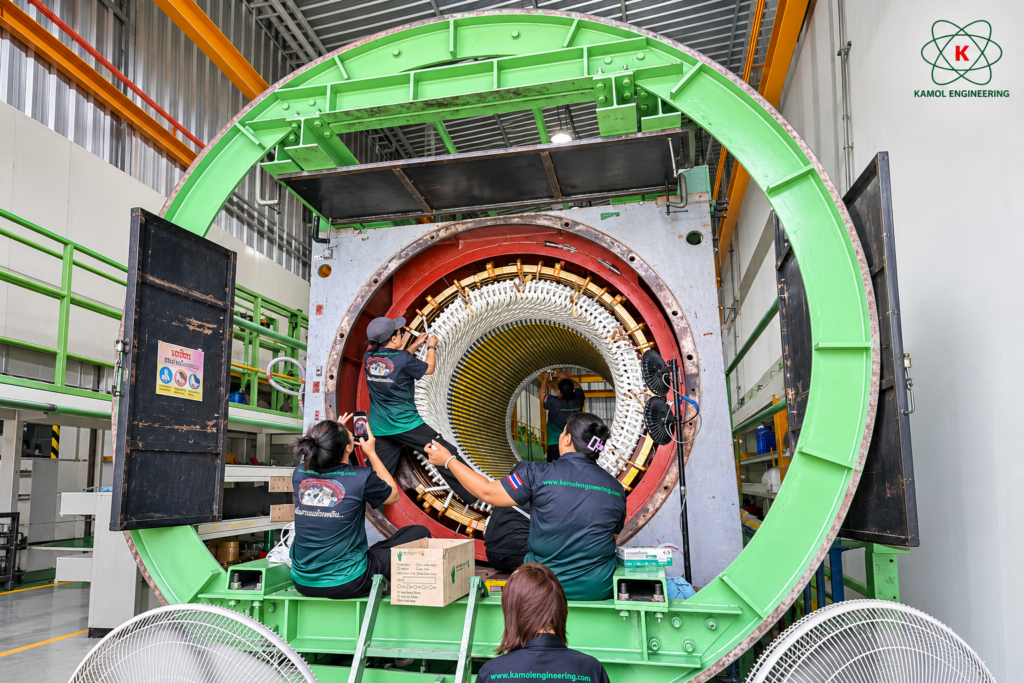
Generator Reference: 48,750 kVA, 4 Poles, 1,500 rpm, 11 kV
The generator associated with the supplied workshop information was described by the following ratings:
| Parameter | Reported Specification |
|---|---|
| Rated Apparent Power | 48,750 kVA (48.75 MVA) |
| Number of Poles | 4 |
| Rated Rotational Speed | 1,500 rpm |
| Rated Voltage | 11 kV |
For a four-pole synchronous generator, 1,500 rpm corresponds to an operating frequency of 50 Hz.
These are generator ratings. The 1,500 rpm figure is not the rotation speed of the workshop positioner.
During normal generator operation, the stator remains stationary while the rotor turns inside it. The workshop fixture serves a different purpose: changing the orientation of the stator as a workpiece during maintenance or winding-related operations.
The generator nameplate and approved technical records should be checked before the ratings are published as independently confirmed project specifications.
Where the Potential Time Savings Come From
The main opportunity is not that the roller fixture makes every individual winding task faster.
It is that some of the handling and setup work between those tasks may be reduced.
Consider a repair that requires access to several sections around the stator. With repeated crane-assisted repositioning, each change may involve another lifting arrangement and its associated checks.
With the stator already supported in a suitable rotating fixture, the team may instead change its angular position through the fixture’s operating controls.
That can help the work progress more continuously, provided the required movement and securing procedures are followed.
What Determines the Actual Benefit?
Several factors influence whether the approach saves time in a particular project:
- The number of angular-position changes required
- The time needed for initial fixture setup
- The stator’s geometry and required working positions
- The time required to verify and secure each position
- The arrangement of platforms, tools and personnel
- Any remaining crane-assisted handling operations
For this example, no measured percentage reduction in work time or project downtime has been provided.
The potential efficiency benefit is therefore a practical engineering expectation, not a quantified performance claim.
Reducing Repeated Crane Lifts Without Overlooking Other Hazards
Moving a large stator with a crane requires careful coordination. Reducing unnecessary repeated lifts can help reduce the number of occasions on which personnel and equipment are involved in those lifting activities.
But a rotating fixture introduces its own hazards.
Depending on the design, these may include moving contact points, roller nip points, unintended rotation, insufficient restraint and contact between the workpiece and surrounding structures.
Remote control should not be presented as a safety feature that makes all these hazards disappear.
Before a fixture is used, the responsible engineering team must assess its suitability for the workpiece and operating conditions.
Important Handling and Safety Considerations
- Verified stator mass and support requirements
- Fixture load rating and stability
- Appropriate workpiece restraint
- Clearance throughout the intended movement
- Protection against contact with hazardous moving parts
- Safe positioning of personnel during rotation
- Procedures for stopping, securing and isolating movement as required
- Approved methods for initial loading and final removal
A crane may still be needed to place the stator into the fixture or remove it when the work is complete.
The engineering objective is to reduce unnecessary repeated lifting, not to claim that lifting equipment is no longer required.
What Engineers Should Check Before Selecting a Stator Positioning Method
A rotation fixture should be evaluated against the specific machine and planned work, rather than selected only because it appears convenient.
Useful questions include:
- What is the actual stator mass and centre of gravity?
- Which areas of the winding must be accessed?
- What angular positions are required?
- How will the stator be supported and restrained?
- Are the fixture’s capacity and operating limits documented?
- How will movement hazards be controlled?
- Which tasks still require separate lifting equipment?
- How will the team verify that each working position is secure?
These questions help connect handling equipment selection with the actual maintenance scope.
How to Evaluate Whether the Fixture Improves the Workflow
The clearest evidence of a productivity improvement comes from the job records, not from the appearance of the equipment.
Useful measurements may include how many crane-assisted repositioning operations were avoided, the time spent preparing and securing each movement, and the total handling-related time across comparable work scopes.
The comparison should account for initial setup time and any additional controls needed when using the fixture.
This makes it possible to distinguish a genuine workflow improvement from an assumption based only on the presence of remote control.
Practical Equipment Support for Large Generator Winding Work
Large-generator maintenance involves more than the winding materials and electrical procedures.
Technicians also need practical access to the areas where work is performed. When the workpiece is large and difficult to move, the method of supporting and positioning it becomes an important part of the repair plan.
A roller-supported rotation fixture can help address that challenge by allowing controlled changes of stator position during suitable work stages.
For the generator described in this article, the reported remote-control arrangement offers a way to reduce repeated crane-assisted repositioning while keeping the stator supported.
Its actual performance and safety depend on the engineering design, operating procedure and conditions of use.
Discuss Your Generator Stator Winding Requirements
Kamol Engineering Services Co., Ltd. provides stator winding and related electrical machine services.
For an initial technical discussion, useful information includes the generator nameplate, stator dimensions and mass, available drawings, winding work scope, and any unusual access or handling constraints.
These details help define the questions that need to be addressed before the work method is selected.
Explore Stator Rewinding Services
Frequently Asked Questions
What is a roller-supported stator rotation fixture?
It is a workpiece-support arrangement that allows a stator to be repositioned through a controlled angular movement. The exact construction, load capacity and operating method depend on the fixture design.
How does remote-controlled stator rotation help maintenance work?
It can make successive winding locations easier to access without arranging a separate crane-assisted lift for every positioning change. The actual benefit depends on the work scope and approved operating method.
Does the system eliminate the need for a crane?
No. A crane or other suitable lifting equipment may still be needed for initial loading, final removal or other handling operations. The fixture is intended to reduce repeated lifting for suitable positioning tasks after the stator is supported.
Is remote-controlled stator rotation automatically safer?
No. It may reduce exposure to some repeated lifting operations, but moving equipment also creates hazards. Safe use requires suitable support, guarding, restraint, personnel separation and approved procedures.
Does 1,500 rpm refer to the stator rotation fixture?
No. The reported 1,500 rpm is the generator’s rated operating speed. For a four-pole synchronous generator, that speed corresponds to 50 Hz. The fixture’s positioning speed is a separate parameter.
What information is needed to assess a rotation fixture?
The stator’s actual mass, dimensions, support requirements, intended movement, available clearances and the fixture’s documented capacity are important starting points. A machine-specific engineering assessment is required.
Technical References
Kamol Engineering — Stator Rewinding
UK HSE — Planning and Organising Lifting Operations
OSHA — Machine Guarding: Hazardous Motions and Actions
Caterpillar — Generator Systems Application and Installation Guide
Editorial note: The generator ratings and remote-controlled roller arrangement were described by the project owner. The fixture’s rated capacity, detailed design, safety functions and measured productivity benefits have not been independently verified. The three gallery images are illustrative and are not identified as photographs of the same generator or rotation fixture. Equipment-specific handling and maintenance require qualified engineering assessment and applicable safety procedures.