

Supporting Heavy Motor and Generator Repair
Moving a large motor or generator component around a workshop takes planning. So does deciding how it should be heated during a repair.
Some winding-related processes require controlled heating. Others involve materials that must reach particular temperatures for specified periods. On a small component, finding suitable processing equipment may be straightforward. On a large machine, the size and weight of the workpiece can become a challenge in their own right.
That is why the supporting equipment in a motor repair workshop matters.
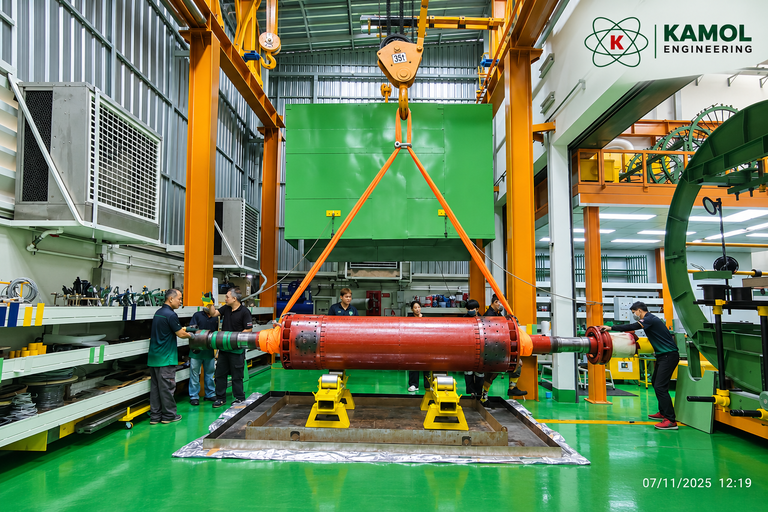
Kamol Engineering Services Co., Ltd. has a large-scale industrial oven intended to accommodate substantial workpieces, including large motors where the equipment and required process are suitable.
The value of a large oven is not simply that a bigger component can fit inside. The workpiece must also be supported properly, heated according to the correct procedure and handled safely before and after the process.
Why Oven Capacity Matters in Large Motor Repair
The size of a motor affects more than transportation and workshop space. It can also determine which repair processes are practical and how the component must be prepared.
Large stators, rotors and other electrical machine assemblies may have considerable mass, extended winding sections and components with different thermal characteristics.
When heating is part of an approved repair procedure, the workshop needs equipment that can accommodate the workpiece without compromising the required clearances, support arrangement or processing conditions.
A large-capacity oven can help address the physical size requirement. However, its suitability for a specific motor still depends on the dimensions, mass, materials and heating process involved.
Physical Size Is Only the First Requirement
A component may fit through an oven opening but still be unsuitable for processing inside it.
Engineers also need to consider the available internal clearance, the workpiece’s weight, the supporting structure, airflow and the temperature requirements of the repair.
There must be enough room for the component to be positioned safely and for the specified heating process to take place as intended.
Workpiece Weight and Support
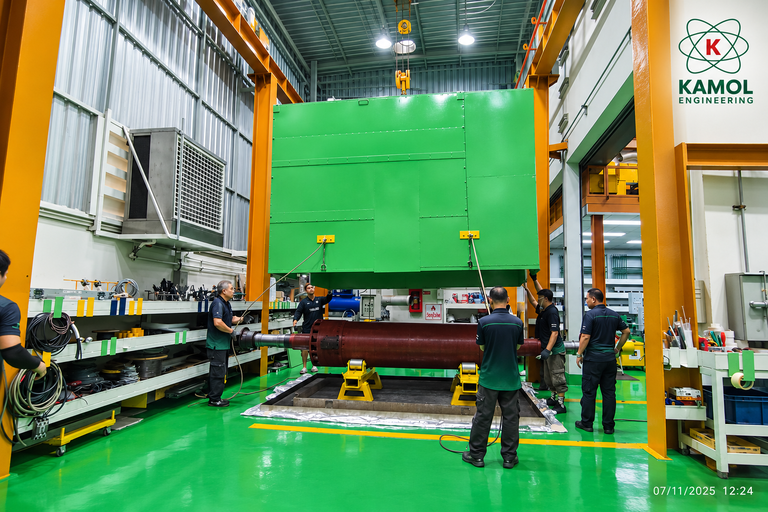
Large electrical machines require suitable handling arrangements before they enter a heating process.
The support method needs to account for the actual workpiece mass, its centre of gravity and the effect of temperature on the materials or fixtures involved.
Crane-assisted loading may be necessary for a heavy component, but lifting capacity and oven load capacity are separate engineering considerations.
A component that can be lifted by the workshop crane is not automatically suitable for placement inside an oven.
Where Controlled Heating Fits Into Motor Rewinding
Not every motor repair requires the same kind of heating. The correct process depends on the component, the insulation system, the materials used and the repair objective.
It is useful to distinguish three common applications.
1. Preheating and Controlled Drying
Some repair procedures require a component or winding to be warmed before the next processing stage.
Controlled drying may also be appropriate when the objective is to address moisture under an approved procedure.
However, heating should not be treated as a universal solution for every low insulation resistance reading or moisture-related problem.
The condition of the insulation, the source of the moisture and the compatibility of the assembly must be considered before selecting a method.
2. Curing Winding Varnish or Resin
During motor rewinding, some insulation treatment systems use varnish or resin that requires a defined curing process.
Once the specified impregnation or coating stage has been completed, controlled heating may be required to develop the intended properties of the material.
The correct curing temperature and duration depend on the actual resin or varnish system, component temperature and the material manufacturer’s instructions.
Heating for too short a period or using unsuitable conditions can leave the material inadequately cured. Excessive or inappropriate heating can damage insulation or other components.
Oven curing is one part of the insulation treatment process. It is not the same operation as varnish impregnation or vacuum-pressure impregnation (VPI).
3. Thermal Removal of Old Winding Insulation
Some electrical machine repair procedures use specialized, temperature-controlled burn-off ovens to help remove old winding insulation before the conductors are stripped from a core.
This is a different operation from curing a newly treated winding.
Burn-off work requires equipment and controls appropriate to that specific process, with particular attention to core temperature, emissions and fire hazards.
The presence of a large industrial oven does not establish that it is approved or equipped for burn-off operations.
For the Kamol oven described here, its confirmed heating applications and operating limits should be established from the equipment documentation before making a project-specific claim.
What Makes an Oven Suitable for a Large Motor?
When assessing whether a particular workpiece can be processed, engineers should look beyond the external size of the oven.
| Consideration | Why It Matters | Information to Confirm |
|---|---|---|
| Internal dimensions | The complete workpiece must fit with suitable clearances. | Workpiece dimensions and usable chamber space |
| Load capacity | The oven floor or support structure must carry the actual load. | Component mass and approved support arrangement |
| Heating process | Preheating, drying, curing and burn-off have different requirements. | Process purpose and equipment suitability |
| Temperature requirements | Materials must receive the correct thermal treatment. | Approved temperature profile and material instructions |
| Airflow and monitoring | Large components may heat unevenly. | Applicable circulation, sensing and monitoring arrangements |
| Handling and safety | Heavy and hot components present distinct hazards. | Lifting plan, access controls and approved operating procedures |
This checklist helps frame an engineering assessment. It is not a claim that every feature listed has been verified for the oven shown in the workshop photograph.
<img
src=”https://kamolengineering.com/wp-content/uploads/2025/10/429006_0_01.webp“
alt=”Large industrial stator with insulated winding sections and exposed slots during winding-related workshop work.”
width=”750″
height=”1000″
loading=”lazy”
decoding=”async”
style=”display:block;width:100%;max-width:650px;height:auto;margin:0 auto;border-radius:8px;” Stator winding work from Kamol Engineering’s published gallery. The image illustrates a winding assembly that may require insulation-related processing; it does not depict an oven cycle or confirm the treatment used on this component.

Why Workpiece Temperature Matters More Than a Setpoint Alone
Large components do not necessarily reach the oven’s indicated temperature at the same moment.
A heavy core or assembly can take time to heat, and different areas may respond differently depending on the materials, geometry and airflow.
This is why an appropriate process may require more than setting an oven controller to a chosen temperature.
The process specification should identify what must be measured, how the component’s temperature is to be assessed and when the required heating period begins.
Follow the Material and Equipment Requirements
For a resin or varnish curing operation, the material manufacturer’s data should guide the required temperature and time conditions.
The oven’s operating instructions, the workpiece construction and the approved repair procedure must also be considered.
A general temperature recommendation taken from another repair job should not be reused automatically.
Keep a Record of the Heating Process
Where the approved process calls for it, useful records may include the workpiece identification, process purpose, selected temperature profile, heating duration, relevant temperature measurements and operator observations.
Those records help engineers understand what was actually done rather than relying only on the fact that a component was placed inside an oven.
Can an Entire Large Motor Be Heated in the Oven?
That depends on the motor and the purpose of the heating operation.
Some work may involve an isolated stator, rotor or another component. Other procedures may call for a larger assembly.
A complete motor may contain bearings, lubricants, seals, sensors, cables, electronic devices or other materials that are not suitable for a particular heating process.
Engineers therefore need to confirm whether those parts can remain installed, whether they must be protected or removed, and whether the complete assembly is mechanically and thermally suitable for the proposed treatment.
A large oven may accommodate the dimensions of a motor without every part of that motor being suitable for the intended temperature.
Handling Large Components Before and After Heating
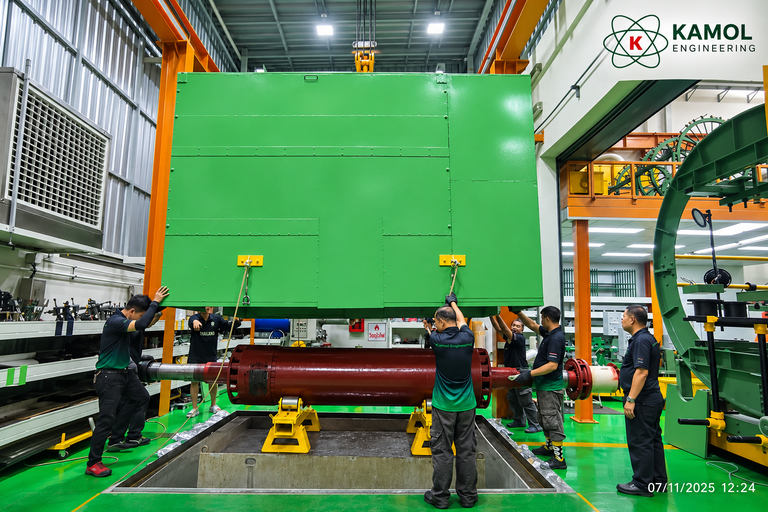
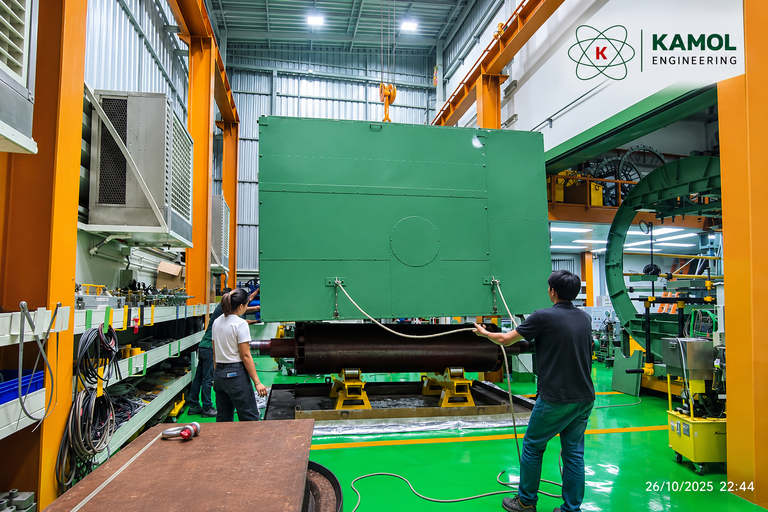
The photograph supplied for this article shows a large cylindrical electrical machine component being handled in the workshop with overhead lifting equipment.
It illustrates the scale of the work involved, but it should not be treated as evidence that a particular lifting method or oven-loading procedure has passed a safety assessment.
Appropriate handling arrangements must be selected for the actual component and lifting equipment.
Before Loading
Important considerations include the workpiece’s mass and centre of gravity, suitable lifting points, the support arrangement and the clearances needed to position it.
The component must also be prepared for the intended process, including identifying temperature-sensitive parts and materials.
After Heating
A large component may retain heat long after the oven cycle has ended.
Removal and subsequent handling should follow the approved cooling and lifting procedures. Workers must be protected from hot surfaces, stored heat and other relevant hazards.
Where varnishes, resins or other chemicals are involved, ventilation and fire precautions must reflect the actual materials and the oven’s intended use.
How a Large Oven Supports the Overall Repair Workflow
For a large motor repair, the workshop has to coordinate several activities: inspection, disassembly where required, winding work, insulation treatment, heating, subsequent inspection and final verification.
The sequence depends on the machine and the approved repair scope.
Having suitable large-capacity heating equipment can reduce the need to seek an external facility for a process that the workshop is equipped and authorized to perform.
It may also make scheduling and handling more straightforward because the work can be planned around available workshop equipment.
However, those are potential workflow advantages. They do not establish a specific reduction in turnaround time or guarantee that every large motor can be processed.
<img
src=”https://kamolengineering.com/wp-content/uploads/2025/10/421176_0_01.webp“
alt=”Formed industrial stator coils with insulated sections and copper conductor ends arranged on a workshop table.”
width=”1000″
height=”450″
loading=”lazy”
decoding=”async”
style=”display:block;width:100%;height:auto;border-radius:8px;” Prepared winding components in Kamol Engineering’s published workshop gallery. Insulation treatment and curing requirements depend on the approved winding design and selected materials.

What Should Customers Provide for a Large-Motor Heating Enquiry?
The best starting point is not simply to ask whether a motor will fit inside the oven.
Provide enough information for the repair team to assess whether the required operation is technically appropriate.
- Motor or generator nameplate information
- Overall workpiece dimensions and mass
- Whether the workpiece is a complete motor, stator, rotor or another assembly
- The required heating purpose and repair stage
- Insulation, resin or varnish information where relevant
- Any temperature-sensitive components
- Available engineering drawings and handling requirements
- The required inspection or documentation scope
These details help determine whether the oven and proposed process suit the actual workpiece.
A Large Oven Is One Part of a Well-Planned Repair
Large heating equipment can provide an important capability in motor and generator repair, particularly when the size of the component makes ordinary workshop equipment unsuitable.
But the oven itself is only part of the answer.
The workpiece still needs to be handled correctly, the heating process must be chosen for the actual materials, and the results need to be evaluated against the agreed repair requirements.
For Kamol Engineering, the large-scale oven described by the workshop owner adds an option for handling substantial motor-related workpieces when the equipment and process are suitable.
The engineering value comes from matching the component, the thermal process and the workshop equipment—not from size alone.
Discuss a Large Motor or Generator Repair Requirement
Kamol Engineering Services Co., Ltd. provides stator and rotor rewinding services for industrial electrical machines.
For a large workpiece requiring heating as part of an approved repair process, the first step is to review the machine details and the intended treatment.
Explore Stator Rewinding Services
Explore Rotor Rewinding Services
Frequently Asked Questions
What is a large industrial oven used for in motor repair?
Depending on its design and approved operating capabilities, an industrial oven may be used for controlled preheating, drying or curing certain winding insulation materials. Specialized burn-off ovens serve a different purpose and require appropriate process-specific controls.
Can Kamol Engineering’s oven accommodate large motors?
The workshop owner reports that Kamol has a large-scale oven capable of accommodating substantial workpieces, including large motors. Suitability for a particular machine must still be confirmed from its dimensions, mass, materials and required heating process.
Does a larger oven automatically provide better curing?
No. Physical capacity alone does not establish curing quality. The correct resin or varnish, heating profile, component temperature and approved process must all be considered.
Is oven curing the same as vacuum-pressure impregnation?
No. VPI is a method used to introduce resin or varnish into a winding insulation system under vacuum and pressure. Oven curing is a separate thermal step that may be required afterward, depending on the material system and process specification.
Can an entire motor be placed in an industrial oven?
Only when the complete assembly is suitable for the intended process. Bearings, lubricants, seals, sensors and other temperature-sensitive components may require special consideration or removal.
How is the correct oven temperature selected?
The temperature and duration should be established from the material manufacturer’s instructions, equipment documentation and approved repair procedure. One universal temperature is not appropriate for every motor or insulation system.
Is the oven shown in the workshop photograph suitable for burn-off?
That cannot be established from the photograph or the current equipment information. Burn-off is a separate process requiring specialized equipment and relevant controls.
Technical References
EASA — ANSI/EASA AR100-2025 Recommended Practice for Repair of Rotating Electrical Apparatus
U.S. Department of Energy — Model Repair Specifications for Low Voltage Induction Motors
UK Health and Safety Executive — Planning and Organising Lifting Operations
Editorial note: The availability of a large industrial oven and its ability to accommodate large workpieces are based on information supplied by the workshop owner. Chamber dimensions, load rating, maximum temperature, thermal control features, supported processes and measured performance have not been independently verified. The original workshop photograph does not establish an active heating cycle. The additional gallery images illustrate winding-related work, not the oven or the same project. Processing and safety requirements must be verified for the specific component and equipment.