

Repair or Replace? A Decision Framework for Critical Industrial Motors

The production line has stopped. A critical industrial motor has failed, and the maintenance team needs to make a decision.
Should the motor be repaired, or is it time to buy a replacement?
It is tempting to begin by comparing two prices. One comes from a repair workshop. The other comes from a motor supplier.
But for a motor that keeps an important industrial process running, the cheapest initial quotation may not represent the most appropriate decision.
The existing machine may be technically repairable but unsuitable for the plant’s current operating requirements. A replacement may offer different efficiency or performance characteristics but require modifications to the installation. A new motor may be available immediately—or it may have a delivery lead time that creates serious production constraints.
The repair-or-replace decision should consider technical condition, operational suitability, reliability, availability and total cost—not purchase price alone.
A structured review helps the engineering and management teams understand which option best addresses the actual problem.
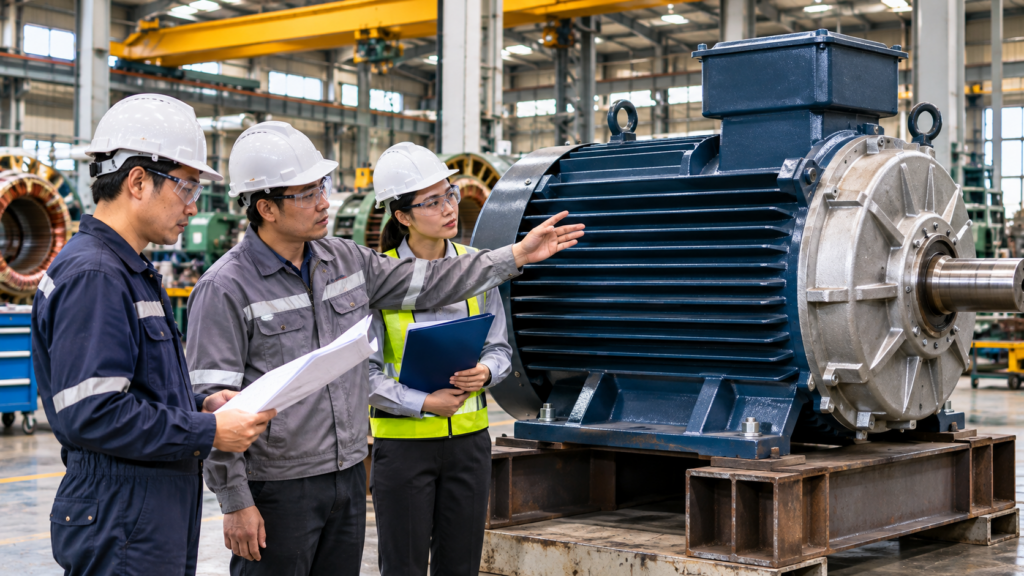
SAMPLE IMAGE 1 — REPAIR OR REPLACE DECISION Suggested hero image: maintenance and engineering personnel reviewing the condition of a large industrial motor before comparing repair and replacement options. Conceptual illustration.
When Should an Industrial Motor Be Repaired or Replaced?
There is no universal answer based only on motor age, power rating or repair price.
Repair may be appropriate when the machine remains suitable for its application, the damage can be addressed through an approved repair process, and the resulting technical and commercial risks are acceptable.
Replacement may be more appropriate when the machine cannot be restored economically or technically, when its design no longer meets the application, or when a suitable replacement provides a better evaluated outcome.
Sometimes neither conclusion can be reached immediately.
An inspection may be needed to establish the condition of the windings, core, rotor, bearings and other relevant components before a responsible decision can be made.
For critical equipment, inspection before commitment can be a valid decision in its own right.
1. Understand the Actual Technical Condition
The first question is not whether a motor looks old or has visible winding damage.
It is what condition the machine is actually in—and which components would need attention to achieve the required operating performance.
A motor may experience an electrical failure while its principal mechanical components remain serviceable. Another motor may show relatively limited winding damage but have significant mechanical or core-related problems.
The appropriate assessment depends on machine design and observed symptoms.
Electrical Condition
Depending on the machine and inspection scope, electrical assessment may consider winding condition, insulation-related evidence, connection integrity, relevant test history and the extent of any damage.
Insulation resistance, winding resistance and other electrical tests can be useful where technically appropriate. However, one electrical test does not establish the condition of every part of a motor.
Testing methods and acceptance criteria must follow the machine design and relevant technical requirements.
Stator Core and Winding Support
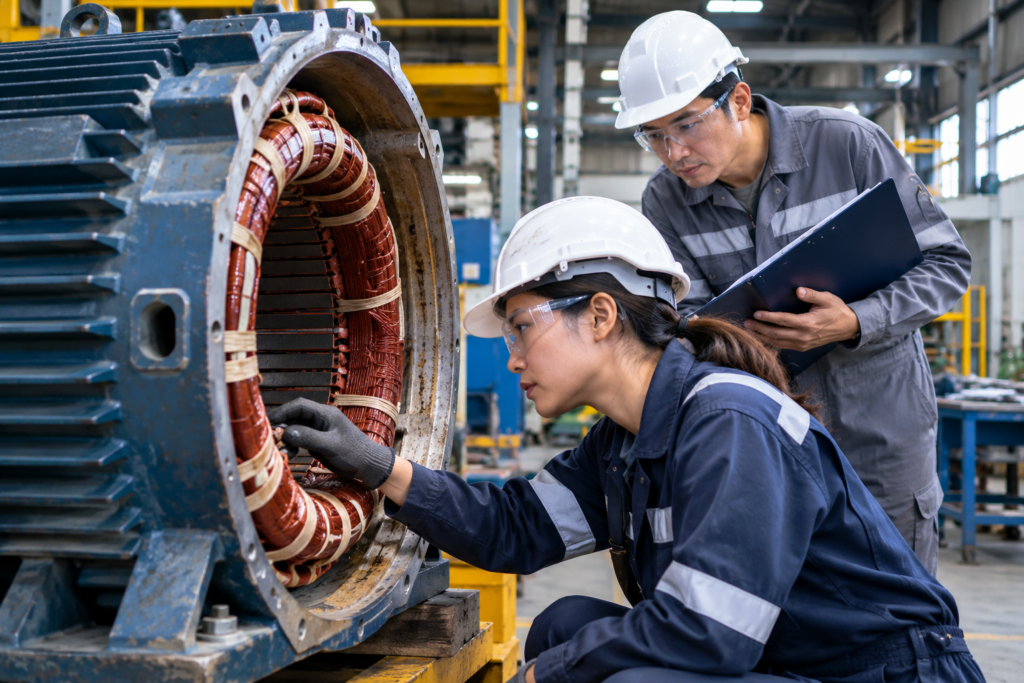
Where a stator winding has been damaged, the core and supporting structures may also deserve attention.
Excessive heat, mechanical damage or previous repair work may affect whether rewinding can be carried out as intended.
The repair team should identify which core-related inspections are necessary before confirming the winding repair scope.
Mechanical Components
Bearings, shafts, bearing housings, seals, rotor condition, cooling arrangements and other mechanical features may influence the decision.
The extent of inspection should reflect the machine and its failure history.
For example, significant shaft or housing damage may change the economics of repair, even when winding replacement is technically possible.
Visible winding damage is evidence of a problem, not a complete definition of the repair.
2. Determine Whether the Motor Is Technically Repairable
Technical repairability means more than finding a workshop that can replace a damaged component.
The proposed work needs to restore the motor to an appropriate, verified condition for its intended service.
Questions worth examining include:
- Can the required winding or component be manufactured or sourced?
- Are the original specifications and necessary drawings available?
- Can the relevant mechanical and electrical defects be addressed?
- Are suitable repair methods and inspection procedures available?
- Can the completed work be evaluated against appropriate acceptance requirements?
- Are any proposed changes to the original design subject to engineering review?
Complex, custom-built and large industrial motors can have specific construction details that make replacement difficult to match. In those situations, repair may be worth serious consideration.
However, repairability does not automatically mean repair is the best choice.
It must be evaluated together with future service demands, cost, time and risk.
3. Check Whether a New Motor Would Really Be a Suitable Replacement
Buying a motor with the same rated power is not always enough to establish interchangeability.
Before approving replacement, engineers should check that the proposed motor suits the electrical supply, driven equipment and installation.
Electrical and Operating Compatibility
Relevant parameters may include:
- Rated power and service duty
- Supply voltage and frequency
- Rated speed and operating speed range
- Starting method and starting characteristics
- Required torque and load profile
- Variable-frequency drive compatibility, where applicable
- Cooling method and environmental requirements
Special-purpose motors may have additional requirements that are not evident from a short catalogue description.
Mechanical and Installation Compatibility
Important questions may include:
- Does the replacement fit the existing foundation?
- Are mounting dimensions and shaft details compatible?
- Can the motor be connected to the driven machine appropriately?
- Will coupling, alignment or support modifications be necessary?
- Are cooling, access and lifting arrangements suitable?
- Will protection, instrumentation or controls require changes?
In a critical application, a motor that is readily available but unsuitable for the installation is not a practical replacement.
Special Operating Environments
Applications involving hazardous areas, unusual ambient conditions or specific safety requirements may need additional review.
Any applicable equipment certification or regulatory requirement must be addressed using the actual installation specifications.
A general-purpose replacement must not be assumed suitable for every industrial environment.
4. Compare Downtime, Not Just Repair and Purchase Prices
When production is interrupted, timing may be a major part of the decision.
But the relevant comparison is not simply repair time versus the delivery time printed in a motor catalogue.
Both options involve a sequence of activities.
The Repair Path May Include
- Safe isolation and removal
- Transport to a suitable repair facility
- Inspection and technical assessment
- Agreement on the repair scope
- Parts or winding manufacture
- Repair, inspection and applicable testing
- Return transport, installation and commissioning
The Replacement Path May Include
- Identifying a technically compatible motor
- Obtaining availability and delivery confirmation
- Reviewing drawings and installation interfaces
- Modifying the foundation or connections if required
- Transport and lifting arrangements
- Installation, alignment and commissioning
- Verification of the complete motor-driven system
A replacement motor may reach the site quickly but still require substantial installation work.
Likewise, a repair may be straightforward in principle but require additional time after inspection reveals unexpected damage.
The comparison should therefore consider the credible return-to-service schedule for each option, including important dependencies and uncertainties.
5. Evaluate Total Life-Cycle Cost
Purchase cost and repair cost are important, but they are only part of the economic picture.
Industrial motors may operate for many hours over their service life. Depending on operating conditions, electricity costs can represent a significant portion of ownership cost.
A replacement with suitable efficiency and operating characteristics may provide an economic benefit in some applications.
However, that benefit should be evaluated from the actual duty cycle, energy price, operating hours and verified efficiency information—not assumed from the fact that a motor is newer.
Compare Both Options Using the Same Evaluation Period
A useful life-cycle comparison may consider:
- Repair quotation or replacement purchase cost
- Transport and handling
- Installation and commissioning
- Expected energy consumption under the plant’s duty cycle
- Maintenance and spare-parts requirements
- Expected future major service or replacement activities
- Reasonably assessed downtime and reliability risks
- Any relevant disposal or end-of-life costs
The analysis should identify the assumptions used and distinguish confirmed costs from estimates.
Where future costs are compared over several years, the plant’s established financial evaluation method, such as a discounted cash-flow analysis, may be appropriate.
Does Rewinding Always Reduce Motor Efficiency?
No. It is not technically sound to assume that every rewind causes an efficiency loss.
Research and industry guidance show that proper repair and rewinding practices can maintain efficiency in the motor designs and conditions studied.
However, that does not guarantee an unchanged efficiency for every large or specialized motor.
The actual outcome depends on motor design, initial condition, repair methods and relevant verification.
Likewise, purchasing a new motor does not guarantee a lower total energy cost unless the replacement is appropriately selected for the application.
6. Consider Reliability and Repeat-Failure Risk
A failed motor may have experienced a one-time event. It may also be operating in conditions that contribute to repeated failures.
Those two situations require different decisions.
If the original failure mechanism has not been understood, replacing the motor may leave the underlying installation or operating problem in place.
Similarly, repairing the same component repeatedly without evaluating the conditions that affect it may not address the wider issue.
Potential influences include:
- Operating duty outside the intended design
- Inappropriate loading or starting conditions
- Cooling restrictions or environmental contamination
- Supply or drive-related stresses
- Mechanical alignment or vibration problems
- Lubrication-related issues
- Inadequate previous repair or maintenance practices
The presence of any one factor should be established from evidence rather than assumed from a failure symptom.
The decision should consider whether the proposed repair or replacement actually addresses the conditions needed for dependable operation.
7. Examine Future Operational Requirements
Sometimes the existing motor can be repaired, but the plant no longer needs the same machine configuration.
Production capacity may have changed. The driven equipment may have been modified. The plant may be considering a different speed-control arrangement or a revised operating duty.
In those circumstances, the repair-or-replace decision becomes an opportunity to reassess the motor’s suitability.
The key question is not simply whether the existing motor can run again.
It is whether the repaired motor—or a proposed replacement—will meet the plant’s actual requirements during the intended service period.
A Practical Repair-or-Replace Decision Matrix
The following matrix helps organize an engineering and management review. It is not a scoring standard, and no single row should determine the answer without considering the other relevant evidence.
| Decision Factor | Repair Consideration | Replacement Consideration |
|---|---|---|
| Technical condition | Damage can be addressed through a suitable repair scope. | Damage is technically impractical or uneconomic to restore. |
| Application suitability | Existing motor still meets present and foreseeable duty requirements. | Operating requirements have changed significantly. |
| Equipment compatibility | Existing machine already matches the installation. | A compatible motor is available or required modifications are acceptable. |
| Return-to-service time | A credible repair path meets the required schedule. | A suitable replacement path offers an acceptable schedule. |
| Life-cycle cost | Evaluated repair and future operating costs are acceptable. | Evaluated replacement benefits justify acquisition and integration costs. |
| Reliability risk | Repair can address the identified defects and support requirements. | Replacement better addresses a demonstrated equipment or application limitation. |
| Future requirements | Original design remains appropriate for expected service. | A revised motor specification better meets future plant needs. |
Important: The matrix is a qualitative decision aid. It does not provide universal numerical thresholds, guarantee outcomes or replace a machine-specific engineering assessment.
Three Situations That Lead to Different Decisions
Scenario A: Repair May Be the Better Option
A large, purpose-built motor has experienced winding damage. Inspection indicates that the other major components remain suitable for the proposed repair, and the original motor still meets the application requirements.
A technically appropriate repair scope is available, while sourcing a compatible replacement would require substantial time or installation changes.
In this hypothetical situation, repair may be the more practical choice.
Scenario B: Replacement May Be the Better Option
An older motor has experienced repeated problems, and the plant has changed the driven equipment and operating duty.
The existing motor no longer provides an appropriate match for the application. A suitable new motor can be selected with acceptable integration requirements and an economically justified operating profile.
In this hypothetical situation, replacement may offer a better long-term outcome.
Scenario C: The Decision Should Wait for Inspection
A critical motor trips during operation, and the available records suggest an electrical problem.
There is not yet enough evidence to determine the condition of the winding, stator core or other components.
Neither the repair scope nor the complete replacement requirements have been established.
In this situation, the next decision may be to authorize a defined inspection and engineering review rather than approve a repair or purchase immediately.
These scenarios are educational examples, not actual Kamol Engineering project results.
How to Compare Repair and Replacement Quotations Fairly
For procurement, comparing the lowest two prices is not necessarily a like-for-like comparison.
One repair quotation may be provisional pending inspection. Another may include removal, rewinding, mechanical work, testing and transport.
A replacement quotation may cover the motor purchase alone without installation modifications or commissioning.
Before comparing totals, ask whether both proposals include the activities required to return the motor-driven system to service.
Separate Confirmed Costs From Assumptions
A useful comparison should identify:
- Confirmed quotation prices
- Scope included and excluded
- Inspection-dependent items
- Expected equipment availability
- Installation or integration requirements
- Estimated downtime exposure
- Energy and maintenance assumptions
- Technical uncertainties requiring further review
Do not use a fixed repair-cost percentage as a universal rule.
Whether repair represents good value depends on the machine, the application and the costs and risks that matter to the plant.
What Information Should Be Available Before the Final Decision?
A decision package should be detailed enough for the maintenance, engineering, procurement and management teams to understand the alternatives.
Useful information may include:
- Machine nameplate and original specifications
- Application and criticality assessment
- Failure history and available evidence
- Inspection findings and unresolved technical questions
- Proposed repair scope and verification plan
- Proposed replacement specification and compatibility assessment
- Repair and replacement schedules
- Cost comparison using consistent assumptions
- Expected operating and maintenance requirements
- Project risks, dependencies and required approvals
If a major item is unknown, it should be identified as an open question rather than filled with an unsupported estimate.
SAMPLE IMAGE 3 — ENGINEERING DECISION REVIEW Suggested image: maintenance, reliability and procurement personnel reviewing repair feasibility, replacement compatibility, downtime and life-cycle cost assumptions.
A Five-Step Decision Process for Critical Motors
Step 1: Make the Situation Safe and Preserve the Evidence
Follow applicable plant procedures for shutdown, isolation and safe access. Preserve nameplate details, operating records, symptoms and available inspection evidence.
Step 2: Establish the Machine Condition
Identify the inspection and testing needed to understand the damage and determine whether a responsible repair scope can be defined.
Step 3: Define Both Feasible Options
Develop a repair proposal based on technical findings and a replacement proposal based on actual equipment compatibility.
Where an option is not feasible, document the reason.
Step 4: Compare Time, Cost and Risk
Evaluate the credible return-to-service schedule, life-cycle economics, future service requirements and relevant uncertainties.
Step 5: Approve the Preferred Option and Its Verification Requirements
Document the engineering rationale, commercial assumptions, responsibilities and acceptance requirements.
Whether the motor is repaired or replaced, suitable installation and commissioning activities still need to be completed.
How Kamol Engineering Fits Into a Repair Assessment
Kamol Engineering Services Co., Ltd. provides winding-related services for industrial motors and generators, including stator and rotor rewinding, made-to-order coils and electrical testing.
For a motor being considered for repair, a technical enquiry can begin with the machine nameplate, available drawings, failure symptoms, photographs, operating history and existing test records.
These details help establish the questions that must be addressed before a suitable repair scope can be discussed.
Actual inspection methods, testing requirements, repair feasibility and quotation conditions need to be confirmed for the machine and proposed work.
This article does not assume that Kamol Engineering supplies replacement motors or provides every type of mechanical overhaul, installation or commissioning service.
Make the Decision Based on Evidence, Not Assumptions
Repair and replacement are not competing philosophies. They are possible technical responses to an equipment problem.
The appropriate choice depends on the condition of the existing machine, the suitability of each option, plant operating requirements and the economic consequences.
Repair can be a responsible choice when the existing motor remains suitable and a verified repair scope addresses the relevant defects.
Replacement can be a responsible choice when the original design no longer meets the plant’s needs or when the evaluated technical and economic benefits justify the change.
And when important facts are missing, inspection and engineering review may be the best place to begin.
For critical industrial motors, the goal is not simply to choose the cheaper option. It is to choose a technically suitable option with a clear understanding of cost, time and risk.
Discuss Your Industrial Motor Repair Requirements
If your team is evaluating whether a critical motor can be repaired, share the available machine information and describe the issue.
Kamol Engineering can be contacted regarding its published rewinding, coil manufacturing and electrical testing services.
Explore Stator Rewinding Services
Explore Rotor Rewinding Services
Explore Made-to-Order Coil Manufacturing
Frequently Asked Questions
Is it better to repair or replace an industrial motor?
It depends on the motor’s actual condition, repair feasibility, replacement compatibility, downtime, life-cycle costs and operational requirements. Neither repair nor replacement is automatically the better option.
When should a large industrial motor be considered for rewinding?
Rewinding may be appropriate when inspection supports a viable winding repair and the machine remains suitable for its intended service. Core, mechanical and other relevant conditions must also be considered.
Does rewinding always reduce motor efficiency?
No. Proper repair practices can maintain efficiency for motor types and conditions supported by relevant studies. However, the actual result depends on machine design and repair quality, so unchanged efficiency cannot be guaranteed for every motor.
Is buying a new motor always faster than repairing?
No. The comparison must include confirmed availability, delivery, installation compatibility, necessary modifications and commissioning. A new motor that does not fit the application may not provide the fastest return-to-service path.
How should repair cost be compared with replacement cost?
Compare technically feasible options over a consistent evaluation period. Include direct work costs, transport, installation, downtime exposure, energy consumption, maintenance and material uncertainties where relevant.
Should an old motor automatically be replaced?
No. Age alone does not establish whether a motor is technically or economically suitable for continued service. Its condition, application and future requirements should be assessed.
What if the motor has failed several times?
Repeated failure should prompt a review of the failure evidence and operating conditions. Both repair and replacement decisions should consider whether the underlying contributors have been addressed.
Can a higher-efficiency motor justify replacement?
Potentially. The benefit depends on verified efficiency, actual loading, annual operating hours, energy prices and the costs of acquiring and integrating the replacement. Newer equipment does not guarantee a better result in every application.
Can the repair-or-replace decision be made before disassembly?
Sometimes sufficient evidence is available to support a decision. In other cases, inspection or authorized disassembly is required to establish the damage and repair scope. Uncertainty should be identified explicitly.
What information should be sent for an initial repair assessment?
Useful information includes the machine nameplate, application, symptoms, photographs, operating history, available inspection and test records, drawings and any important shutdown or handling constraints.
Technical References
EASA — Electric Motors: Repair or Replace?
EASA — ANSI/EASA AR100-2025 and Motor Rewind Study Resources
U.S. Department of Energy — Improving Motor and Drive System Performance
U.S. Department of Energy — Continuous Energy Improvement in Motor Driven Systems
Kamol Engineering — Stator Rewinding
Editorial note: This article is an educational repair-versus-replacement decision guide. It is not a machine-specific recommendation or an actual project case study. The scenarios and comparison matrix are illustrative. No universal repair-cost percentage, motor-age limit, performance guarantee or service-life prediction is implied. Actual decisions require qualified engineering assessment, current supplier quotations, verified equipment compatibility and appropriate safety and technical requirements. The workshop gallery photograph is illustrative and is not evidence of a particular repair-versus-replacement result.