What Should a Motor Repair Test Report Include?
The motor has been repaired, and the workshop has completed its assigned work.
Before the equipment is returned to the plant, the maintenance engineer receives a test report.
It contains several measurements, a few remarks and perhaps a statement that the motor has passed inspection.
But does the report provide enough information to understand what was actually tested?
For critical industrial motors, a repair test report should do more than present a collection of numbers.
It should identify the equipment, explain the completed repair scope, document the applicable inspections and tests, record the relevant conditions and results, and show how those results were evaluated.
It should also make clear what was not tested, what remains uncertain and which activities may still be necessary before the machine returns to operation.
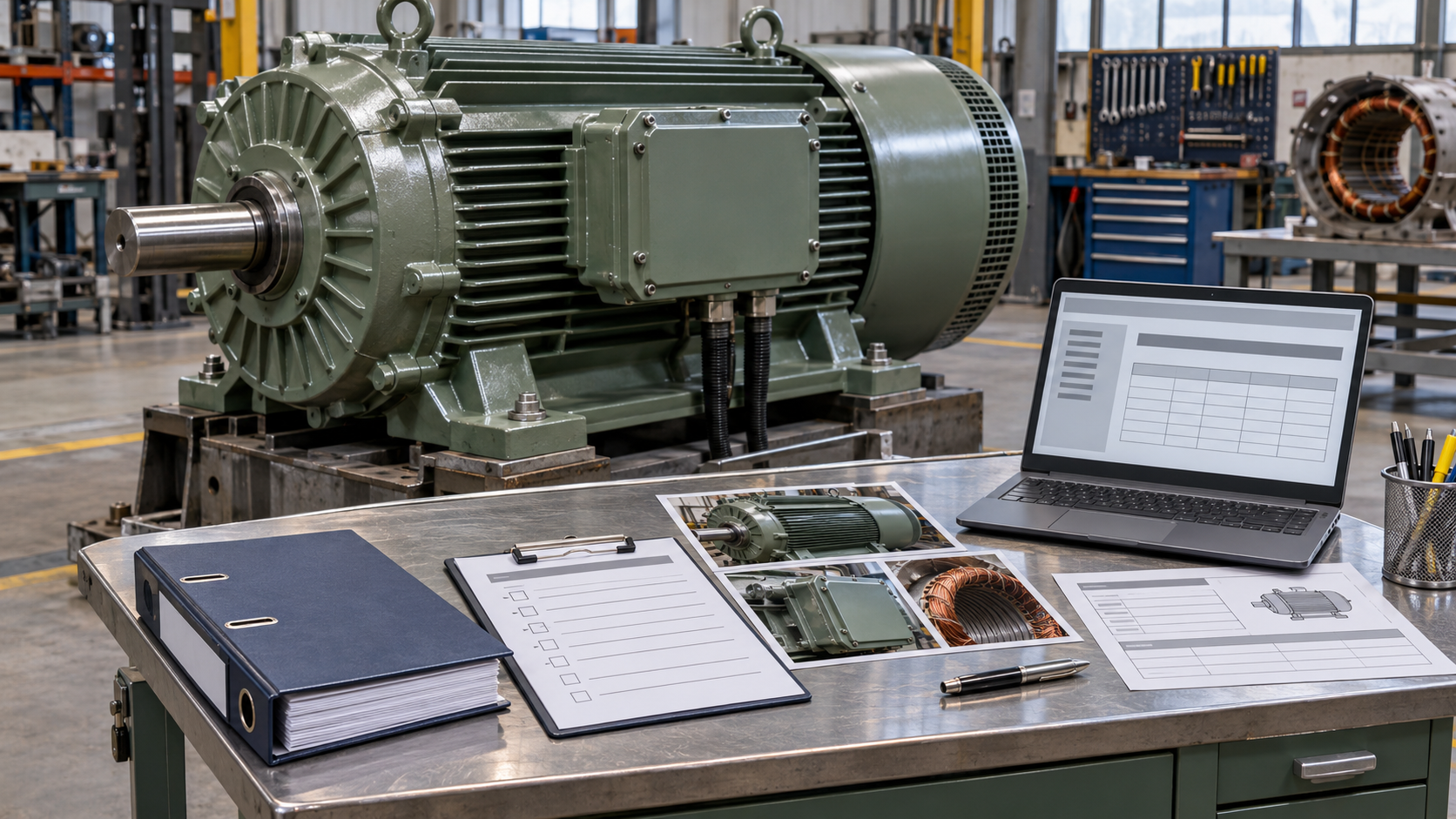
A useful motor repair test report connects the completed work to documented technical evidence. It does not simply say that the motor has passed.
SAMPLE IMAGE 1 — MOTOR REPAIR TEST REPORT REVIEW Conceptual image placement: an electrical engineer reviewing repair documentation and test results before the repaired motor is released for the next stage of service preparation.
Why Is a Motor Repair Test Report Important?
A repair report creates a technical record of the condition assessed, the work performed and the checks completed.
That record can be valuable to several people.
The maintenance engineer needs to understand the condition of the machine before installation. The reliability engineer may need reference information for future evaluation. Procurement may need to confirm that the agreed deliverables have been supplied.
For the repair team, the report provides a structured way to communicate the completed scope and relevant findings.
However, a report is only useful if its information is clear enough to interpret.
A statement such as “Insulation resistance: Pass” may be insufficient when the test conditions and criteria are not identified.
Likewise, a vibration measurement without its location, speed or operating condition may be difficult to compare with later measurements.
The aim is not to make every report unnecessarily long. It is to make the important evidence understandable and traceable.
1. Identify the Machine and Repair Job
The first section of a motor repair test report should establish exactly which equipment the document concerns.
Basic identification is especially important when a plant operates several similar motors or when multiple components are handled during the same outage.
Useful Identification Information
- Customer or project reference, where permitted
- Motor manufacturer and model, if available
- Machine serial number or equipment identification
- Repair job or work-order number
- Motor type and relevant nameplate ratings
- Component covered by the report
- Inspection and testing dates
- Report number and revision
The report should distinguish a complete motor from a stator, rotor or other component when only part of the machine has been supplied for repair.
For example, a test report for a rewound stator is not automatically a test report for the complete assembled motor.
If important nameplate information is unavailable, the limitation should be stated rather than replaced with an estimate.
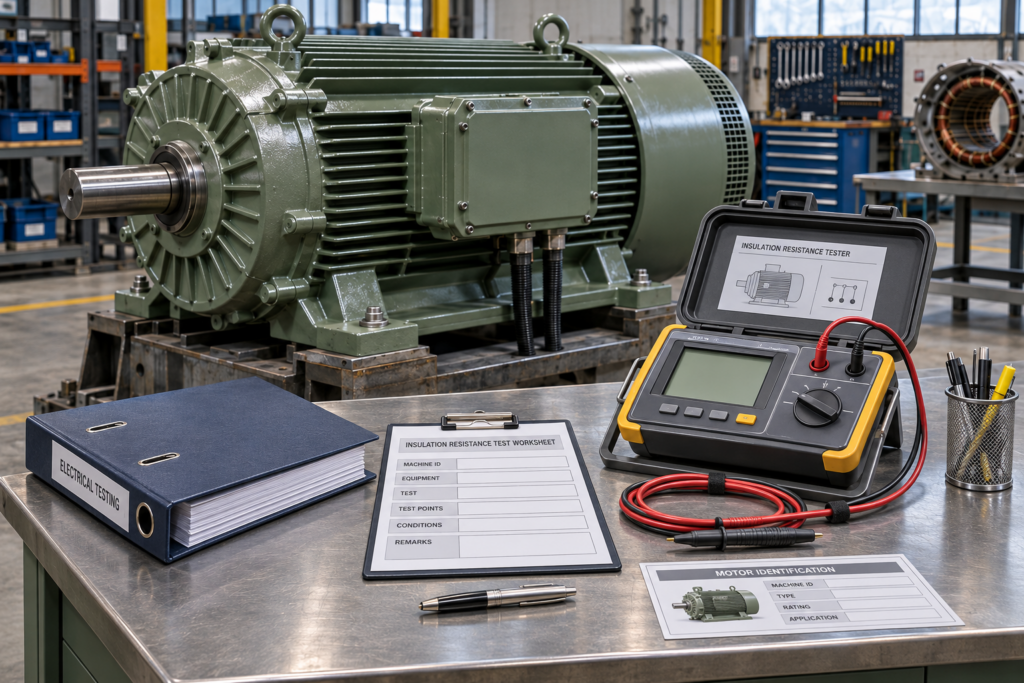
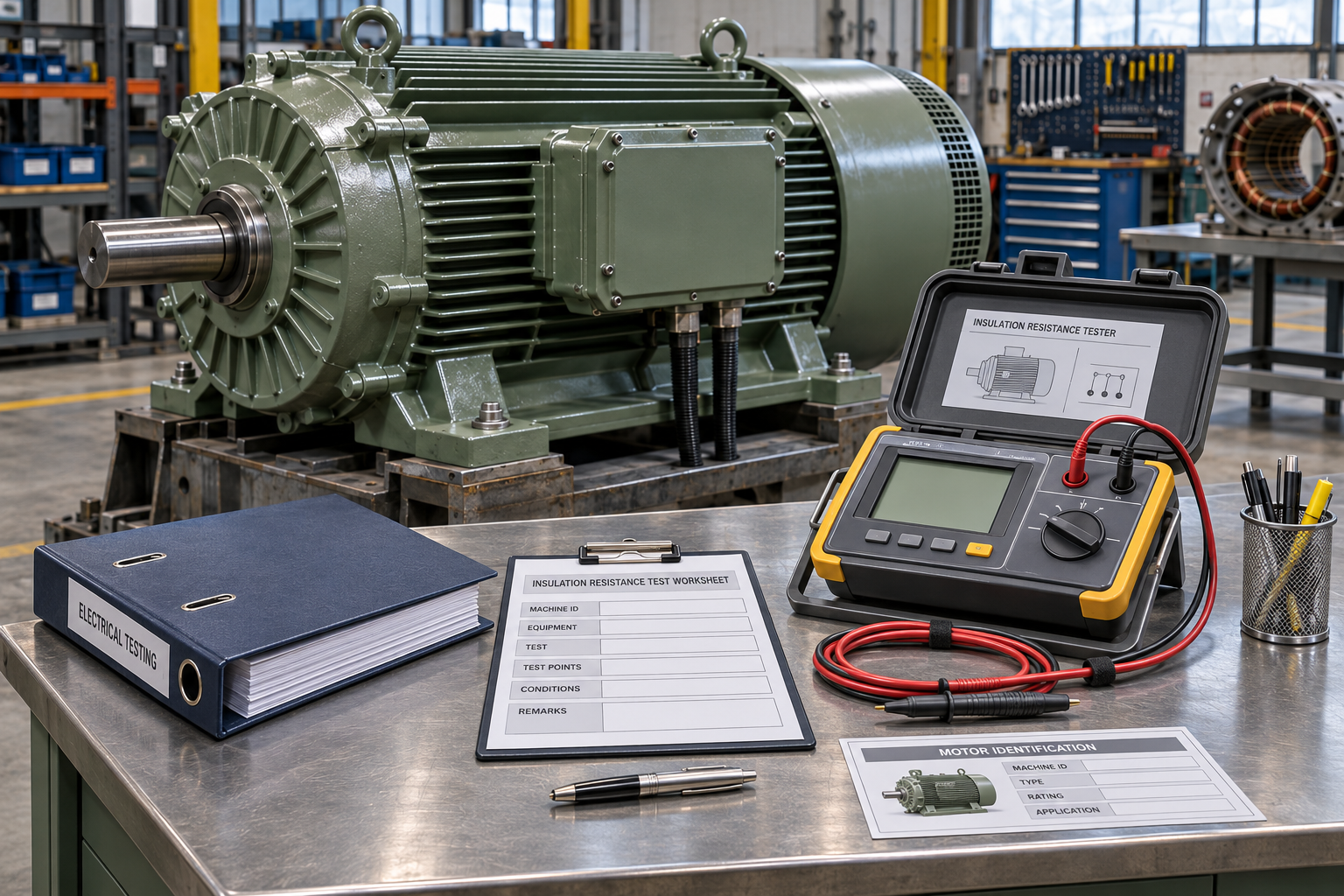
2. Describe the Repair Work Actually Performed
The report should provide enough repair history to explain why the selected inspections and tests were performed.
A motor that received a stator rewind may require a different verification scope from one that received only bearing-related work.
Similarly, replacing a damaged connection is not the same as rebuilding an entire winding system.
What Should the Repair Summary Explain?
Depending on the project, relevant information may include:
- Initial condition or reason for repair
- Components inspected or removed
- Winding repair or replacement work
- Mechanical work completed
- Core-related inspection or corrective work
- Insulation treatment, where applicable
- Approved changes from the original repair scope
- Outstanding work, if any
The summary should distinguish observations from confirmed diagnoses.
If the underlying cause of failure has not been established, the report should not imply that replacing a damaged winding has proven the root cause.
Repair completion and root-cause confirmation are different engineering outcomes.
3. List the Inspections and Tests Performed
One of the most useful sections is a clear record of which inspections and tests were completed.
The correct test plan depends on the motor design, work scope, manufacturing stage and applicable requirements.
Not every motor requires every available electrical test.
A good report should make the selected test scope visible without suggesting that tests outside that scope were performed.
Electrical Tests
Depending on the machine and approved procedure, the report may cover some of the following:
- Insulation resistance measurements
- Polarization index or other applicable insulation assessment
- Winding resistance measurements
- Surge comparison testing, where appropriate
- Dielectric withstand testing, where specified
- Insulation power factor or dissipation factor testing, where applicable
- Core-related testing, when included in the repair scope
- Other winding or circuit-specific electrical measurements
These tests answer different questions.
For example, insulation resistance testing assesses aspects of the insulation system relative to ground under the specified conditions.
Winding resistance testing may support assessment of conductor and connection-related characteristics.
Surge comparison testing may provide information about certain turn-insulation or winding conditions when the method is appropriate for the winding design and stage of repair.
A selected dielectric withstand test evaluates performance under a specified electrical stress. It is not a universal demonstration of future reliability.
The report should not treat these tests as interchangeable.
Mechanical Inspections and Tests
Where mechanical work forms part of the project, the report may also reference checks such as:
- Relevant dimensional inspections
- Shaft or component runout measurements
- Bearing-related inspections and clearances
- Rotor or assembly balancing records, where applicable
- Alignment or assembly observations within the agreed scope
- Mechanical condition observed during a test run
Only the checks actually completed should be reported as performed.
Acceptance requirements must be appropriate for the machine design and work scope.
4. Record the Test Conditions, Not Just the Result
Imagine reviewing two insulation resistance results obtained at different temperatures.
The numerical difference may look significant, but direct comparison could be misleading if the measurement conditions were not considered.
This illustrates why test conditions matter.
Depending on the test, a useful record may include:
- Test method or procedure reference
- Measurement date
- Instrument identification
- Applied test voltage or excitation conditions
- Test duration
- Winding or component temperature
- Ambient conditions, where relevant
- Connections and measurement configuration
- Relevant instrument settings
Instrument calibration status or traceable equipment information may also be required by the project quality system.
These details help the reader understand how the result was obtained and whether it can reasonably be compared with earlier or later measurements.
Why Temperature Matters for Insulation Resistance
Insulation resistance can vary with temperature, moisture and other conditions.
Where the applicable procedure requires temperature correction, the report should identify the method and provide sufficient information to understand the corrected result.
However, the treatment of results must follow the actual insulation system and relevant testing guidance.
A measured value should not be presented as directly comparable with another measurement when important conditions differ.
Why Winding Resistance Requires Context
Winding resistance also depends on conductor temperature.
When comparing winding resistance measurements, engineers may need to consider temperature correction, measurement method, connection configuration and instrument capability.
A numerical difference cannot automatically be assigned to a winding defect without evaluating those factors.

5. Present Actual Results With Units and Measurement Points
Once the method and test conditions are clear, the report must present the actual observations or measured results.
For a measurement, the reader should be able to identify what was measured and where.
Depending on the test, this may involve:
- Phase or winding identification
- Test points and electrical connections
- Measurement direction or physical location
- Measured values with correct units
- Any applicable correction or calculation
- Associated waveform, graph or photograph
- Relevant observations made during the test
For example, a resistance result should identify whether it refers to a phase winding, a phase-to-phase connection or another specified circuit arrangement.
A vibration result should identify the measurement location, direction and operating conditions where relevant.
Generic phrases such as “normal reading” or “good condition” do not replace the measurement record when numerical results are required.
Should the Report Include Graphs and Waveforms?
When a test method produces information that is best evaluated visually, an appropriate waveform, graph or recorded trace may be useful.
The report should identify what the figure represents and which machine or component it relates to.
A waveform without suitable test context may be difficult to interpret.
Likewise, a graph should not be presented as evidence of a successful result unless its applicable evaluation criteria have been met.
6. Explain the Acceptance Criteria
A measured value becomes more meaningful when the reader understands how it was evaluated.
The report should therefore identify the applicable acceptance basis.
Depending on the project, this might come from:
- Manufacturer instructions
- Approved repair specifications
- Agreed customer requirements
- Applicable industry standards or recommended practices
- Validated engineering procedures and criteria
The applicable criteria must match the machine, test method and stage of repair.
For example, a test performed on an isolated winding during manufacture may not use the same evaluation basis as a test performed on an assembled machine in service.
It is inappropriate to apply one universal insulation resistance, surge or high-potential test criterion to every motor.
What Does “Pass” Actually Mean?
A pass statement should mean that the specified result satisfied the applicable criterion for that test.
It should not be interpreted as proof that every component of the motor has been evaluated or that no future failure can occur.
For meaningful review, the report should connect:
- The identified test
- The applicable test conditions
- The actual result
- The agreed acceptance requirement
- The resulting technical assessment
If the requirement is not documented, a simple “Pass” label may leave an important question unanswered.
7. Separate Test Status From Engineering Disposition
Not every inspection or test will produce a straightforward pass-or-fail result.
Some measurements require further review. Others may be limited by equipment access, machine condition or an incomplete repair stage.
A useful report should distinguish these situations.
Examples of Clear Reporting Status
- Completed — Meets Applicable Criteria: The performed test satisfied the identified requirement.
- Completed — Further Evaluation Required: Findings need additional assessment before a technical conclusion can be made.
- Not Performed: The test was not carried out; the reason or scope limitation should be stated.
- Not Applicable: The test is not relevant to the machine or agreed scope, with an explanation where necessary.
- Pending: A planned inspection, test or required review has not yet been completed.
These are illustrative reporting categories rather than a prescribed standard classification system.
Where a nonconformity is identified, its treatment and authorized disposition should be recorded according to the relevant project requirements.
An unresolved failure should not be hidden behind an overall report summary.
Motor Repair Test Report Checklist
The following matrix illustrates information that can help make a repair test report understandable to maintenance, reliability and procurement teams.
| Report Section | What It Should Explain | Customer Review Question |
|---|---|---|
| Machine identification | Which motor or component was evaluated | Does the report match our equipment? |
| Repair scope | What work was actually completed | Does this match the agreed work scope? |
| Inspection and test scope | Which checks were performed | Were the required tests included? |
| Test method and conditions | How and under which conditions measurements were taken | Can the results be interpreted correctly? |
| Measured results | Relevant values, units, locations and observations | Is the underlying evidence available? |
| Acceptance criteria | The applicable basis used to evaluate results | What does a pass statement mean? |
| Deviations and limitations | Unresolved findings, exclusions and work not performed | Which issues still require attention? |
| Review and authorization | Who reviewed the report and what release decision was made | What has actually been approved? |
This matrix is an educational checklist. It does not mean that every repair must include the same tests or document format. Project-specific reporting requirements should be agreed in advance.
8. Distinguish Workshop Tests From Full-Load Performance Testing
A major source of misunderstanding is the assumption that a workshop test proves how the motor will perform under every condition at the plant.
That is not necessarily the case.
A repair workshop may perform inspections and tests on an isolated component, an assembled motor or the complete machine under a particular test arrangement.
A no-load test can provide valuable information about certain operating characteristics. However, it does not automatically establish full-load efficiency, rated-load temperature rise or performance under the plant’s driven-equipment conditions.
What Should a No-Load Test Report Identify?
Where a no-load test is performed, relevant information may include:
- Test voltage and frequency
- Operating speed
- Measured current and other specified electrical quantities
- Vibration measurement details
- Observed temperatures and test duration, where relevant
- Test arrangement and operating conditions
- Abnormal observations during the run
The report should make clear that the machine was tested under no-load or another defined condition.
It should not describe an unloaded workshop test as proof of complete performance under rated mechanical load.
What If the Workshop Cannot Perform a Full-Load Test?
That limitation should be stated clearly.
Depending on the contract and machine, additional verification may be required after installation or during commissioning.
The report should identify the test boundary rather than imply that a broader assessment has been completed.
9. Include Engineering Remarks and Outstanding Issues
The engineering remarks section gives meaning to the measured results.
For example, an engineer may need to explain why a particular result requires follow-up, why a measurement could not be obtained or why a specific test was excluded from the approved scope.
Useful remarks might cover:
- Abnormal findings that remain under review
- Conditions observed during disassembly or assembly
- Changes to the planned repair work
- Restrictions or assumptions affecting interpretation
- Recommended additional inspection
- Pending testing or customer approval
- Installation or commissioning considerations relevant to the repair
Remarks should distinguish technical observations from recommendations.
A recommendation to investigate a possible problem is not the same as a confirmed diagnosis.
10. Confirm Report Review and Release Status
Before a repaired motor is released, the necessary technical and quality reviews should be completed according to the agreed project process.
A useful report may identify:
- Person or role responsible for preparing the record
- Technical reviewer or approver
- Report date and revision
- Open items or required approvals
- Release status and any limitations
These details help the customer understand whether the documentation is preliminary, complete or still subject to further action.
However, a workshop release approval should not automatically be interpreted as authorization to energize the machine at the plant.
Installation checks, alignment, protection-system checks and commissioning requirements may still apply.
What Does a Useful Repair Report Look Like?
A report does not have to be complicated to be useful.
Its structure should allow a reader to follow the chain of evidence from the completed work to the technical conclusion.
A practical report might be organized as follows:
- Machine and job identification
- Initial condition and agreed work scope
- Repair activities completed
- Inspection and test schedule
- Test methods, conditions and instruments
- Measured results and applicable criteria
- Engineering findings and any deviations
- Limitations and outstanding work
- Final review and release decision
- Supporting photographs, drawings and test attachments
Some projects may need more detailed records, particularly when the machine is specialized or the repair requirements are complex.
Other projects may use shorter reports with supporting attachments.
The important point is that the documentation should remain technically meaningful.
SAMPLE IMAGE 3 — TEST REPORT & QUALITY REVIEW Conceptual image placement: engineers reviewing test methods, inspection findings and report completeness before motor repair documentation is released.
Five Questions Customers Should Ask Before Accepting a Repair Report
1. Does the Report Identify the Correct Machine?
Check that the machine or component identification agrees with the equipment delivered for repair.
2. Does It Explain What Was Repaired?
Compare the recorded work with the agreed scope, including any approved changes.
3. Are the Required Tests and Actual Results Documented?
Confirm that the specified inspections and tests are included and that their results can be understood.
4. Are the Acceptance Criteria and Limitations Clear?
Review how the results were evaluated and whether any exclusions or unresolved findings remain.
5. What Has Been Approved for Release?
Determine whether the document supports completion of the workshop scope or whether additional work is still required before installation or return to service.
A Test Report Should Support Engineering Decisions
A motor repair report should not be treated as a formality completed only because the job is finished.
It is a technical handover document.
When machine identification, repair scope, inspection methods, test conditions, actual results and acceptance criteria are recorded clearly, the information becomes more useful to everyone responsible for the equipment.
It helps the maintenance team understand the completed work and gives reliability engineers a documented reference for later assessment.
It can also make commercial and technical discussions more transparent when questions arise about the agreed scope.
The strongest repair report is not necessarily the one containing the most pages. It is the one that allows the customer to understand what was done, what was verified and what remains outside the completed assessment.
Discuss Motor Repair and Electrical Testing With Kamol Engineering
Kamol Engineering Services Co., Ltd. provides industrial motor and generator rewinding, coil manufacturing and electrical testing services.
Its published electrical testing information includes equipment for insulation resistance, winding-related measurements, surge comparison and other specialized electrical assessments.
The appropriate tests, documentation and acceptance requirements must be confirmed for each machine and agreed scope of work.
When sending a repair enquiry, customers can include any specific requirements for inspection records, test reports and technical handover documentation.
Explore Electrical Testing Services
Explore Stator Rewinding Services
Explore Rotor Rewinding Services
Frequently Asked Questions
What should be included in a motor repair test report?
A useful report should identify the equipment, describe the repair scope, list the applicable inspections and tests, record methods and conditions, present results and acceptance criteria, and explain relevant findings, limitations and release status.
Does every repaired motor need the same electrical tests?
No. Test selection depends on the motor type, winding design, work scope, repair stage and applicable requirements. The test plan should be appropriate for the equipment being evaluated.
Is insulation resistance testing enough to confirm a motor is ready for service?
Not by itself. Insulation resistance testing provides information about aspects of the winding insulation system under specified conditions. It does not assess every electrical, mechanical or installation-related requirement.
Should a test report include actual numerical values?
Where numerical measurements are required, the report should normally preserve the relevant values and units, together with the test conditions and evaluation basis. A simple pass statement may not provide enough information for technical review.
What is the difference between insulation resistance and winding resistance testing?
Insulation resistance testing assesses insulation-related characteristics under an appropriate test procedure, while winding resistance testing evaluates the resistance of specified conductor circuits or connections. They answer different engineering questions.
Can a surge test be performed on every motor winding?
Not automatically. The suitability of surge testing and its required test conditions depend on the winding design, condition, manufacturing stage and applicable procedure. It should not be applied indiscriminately.
Does a passing high-potential test guarantee future insulation reliability?
No. A dielectric withstand test evaluates the insulation under specified test conditions. It does not guarantee that the insulation system will remain free from defects or future deterioration.
Does a no-load motor test confirm full-load performance?
No. A no-load test evaluates the machine under its particular test arrangement. It does not automatically establish full-load efficiency, temperature rise or performance when connected to the driven equipment.
Why should test conditions be included in the report?
Conditions such as temperature, applied voltage, test duration and measurement arrangement can influence results. Recording them helps engineers interpret the findings and determine whether comparisons are meaningful.
Can a motor be released if some tests were not performed?
That depends on the agreed work scope, applicable requirements and technical disposition. Any required test that was not performed should be identified, with its status and the necessary next steps made clear.
Is a workshop test report the same as a commissioning report?
No. A workshop report documents inspections and tests performed within the repair scope. Commissioning evaluates additional installation and operating requirements under the applicable site procedures.
Can a test report guarantee that a repaired motor will not fail again?
No. Appropriate testing can provide evidence of condition and compliance with specified requirements at the time of assessment, but it cannot eliminate every future operating risk.
Technical References
EASA — ANSI/EASA AR100-2025: Recommended Practice for the Repair of Rotating Electrical Apparatus
EASA — Electrical Testing of Three-Phase Motors
EASA — Performing an Insulation Resistance Test
Kamol Engineering — Electrical Testing
Editorial note: This article is an educational guide to motor repair test-report content. It is not a prescribed reporting format or a record of a specific Kamol Engineering project. Test selection, procedures, acceptance criteria and documentation requirements depend on the machine and agreed repair specification. The original equipment photograph does not represent a customer test result. All sample-image placements are conceptual, and no actual performance, compliance or reliability outcome is implied. Customers should confirm available reporting deliverables and technical requirements for their specific project.