Return-to-Service Readiness: What to Verify Before Restarting a Repaired Motor
The repaired motor has arrived back at the plant.
The workshop tests have been completed, the repair documentation is available, and the production team is waiting for the machine to return to operation.
Everyone wants to restart as soon as possible.
But before the start command is given, there is an important engineering question:
Is the repaired motor ready to operate as part of the complete industrial system?
A satisfactory workshop test result is an important milestone. However, the motor will now operate with its actual power supply, driven equipment, mechanical installation, cooling arrangements and protection systems.
Each of these introduces conditions that may differ from the workshop test environment.
Return-to-service readiness is the process of establishing that the repaired machine, its installation and its associated systems satisfy the applicable requirements for an authorized restart.
The objective is not simply to energize the motor. It is to establish a technically justified and controlled path back to operation.
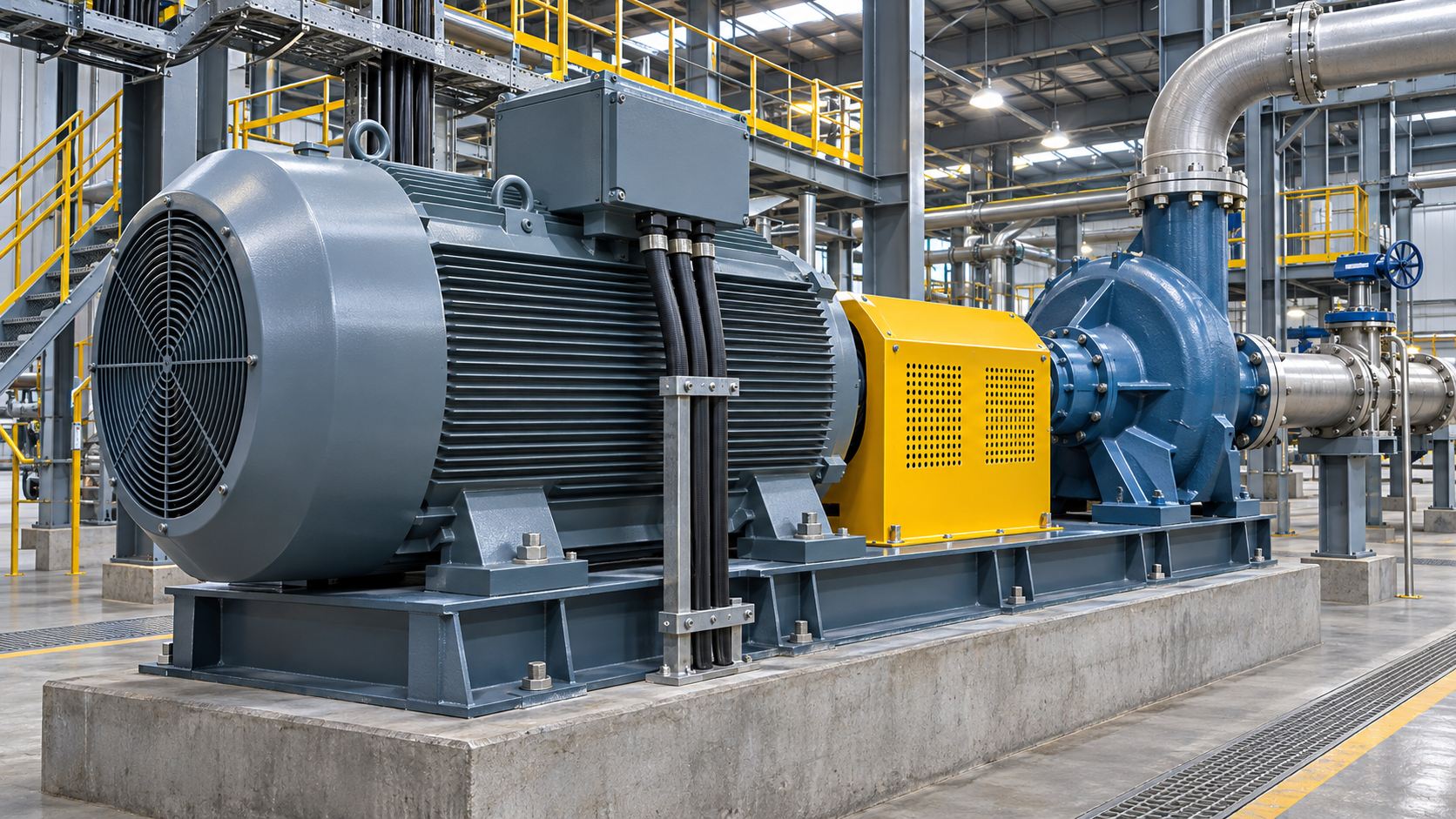
SAMPLE IMAGE 1
MOTOR RETURN-TO-SERVICE READINESS Conceptual illustration of an installed industrial motor and driven equipment with a coupling guard. Not an installation drawing or evidence of a completed commissioning activity.
What Is Motor Return-to-Service Readiness?
Motor return-to-service readiness is an assessment of whether a repaired electric motor and the equipment associated with it are prepared for the next authorized stage of operation.
Depending on the machine and repair scope, this may include reviewing repair records, assessing the mechanical installation, verifying electrical connections, checking auxiliary systems and confirming that relevant protection functions are available.
It is important to distinguish four related but separate stages of equipment recovery.
| Stage | Primary Engineering Question |
|---|---|
| Workshop repair acceptance | Has the agreed repair scope been completed and appropriately verified? |
| Pre-start verification | Is the installed equipment ready for an authorized first start? |
| Site commissioning | Does the installed system behave acceptably during the defined commissioning activities? |
| Routine condition monitoring | How does the machine’s condition change during continued service? |
These activities support one another, but completing one does not automatically establish that all the others have been completed.
1. Review the Repair Scope and Handover Documentation
Before reinstalling or restarting a repaired motor, the plant should understand what work was performed and what evidence is available.
A complete stator rewind, a bearing replacement and a limited electrical repair do not necessarily require identical verification activities.
Relevant handover information may include:
- Machine identification and nameplate information
- Completed repair and replacement scope
- Inspection and electrical test records
- Applicable mechanical verification records
- Engineering observations and unresolved findings
- Changes to components or machine configuration
- Handling, storage or installation recommendations
- Outstanding site activities and agreed responsibilities
Where changes have been made to the original design, the relevant drawings and technical instructions should reflect the approved configuration.
The published scope of ANSI/EASA AR100-2025 covers recommended repair practices, records and testing for rotating electrical apparatus. Its guidance should be considered alongside the applicable machine manufacturer’s instructions and project-specific requirements.
Do Not Confuse Repair Completion With Site Approval
A repair report describes the condition and work within its documented scope.
It does not automatically authorize the plant to energize the motor, particularly when installation and system-related verification activities remain outstanding.
2. Confirm Equipment Condition After Transport and Storage
The condition of a motor when it leaves the repair workshop may not be identical to its condition when it is installed.
Transport, handling and storage can introduce additional concerns.
A receiving inspection may identify visible damage, contamination, moisture exposure, displaced protective materials or issues involving attached components.
Where applicable, engineers should also confirm the status of transport restraints, shaft-locking arrangements and preservation measures before operation.
These features must be managed according to the machine manufacturer’s instructions.
A motor that has remained in storage for an extended period may require additional assessment of its insulation, bearings, lubrication and other relevant systems.
Previously recorded workshop results remain useful, but they may not replace checks required after transport or storage.
3. Verify Mechanical Installation and Alignment
The repaired motor must operate within its actual mechanical installation.
A satisfactory workshop run cannot establish the condition of the plant foundation, coupling arrangement or driven machine after reinstallation.
Foundation and Mounting Condition
The foundation and mounting arrangement should provide suitable support for the motor.
Relevant concerns include mounting stability, soft foot, damaged support surfaces and installation conditions that may distort the machine frame.
Acceptance should be based on the specified installation requirements rather than the appearance of the foundation alone.
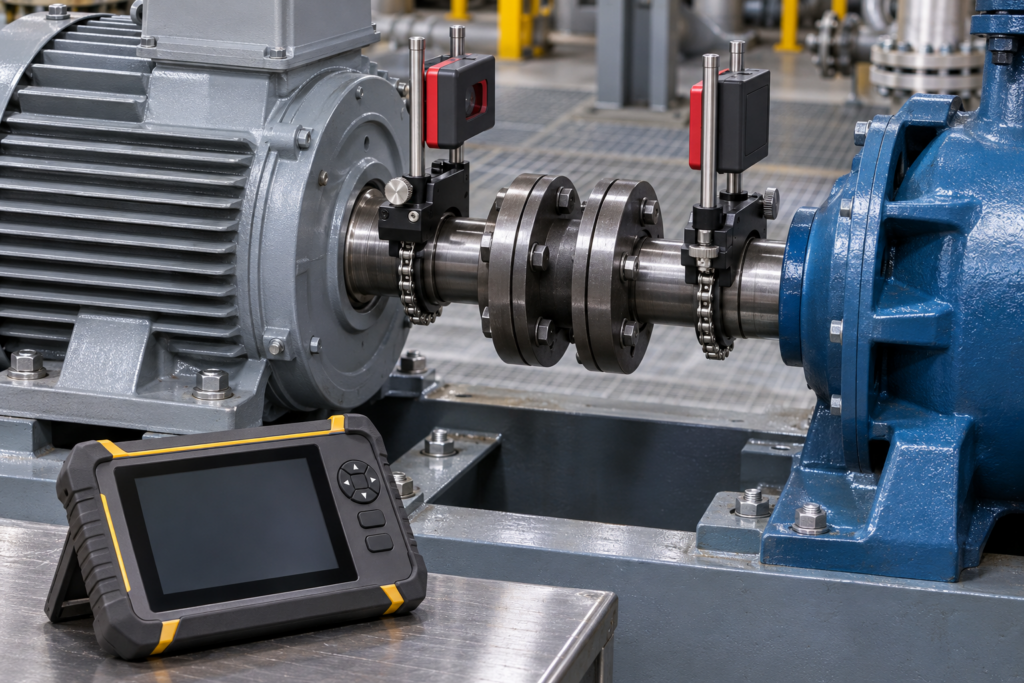
Shaft and Coupling Alignment
The relationship between the motor shaft and the driven equipment is an important part of installation quality.
Misalignment can increase mechanical loading, vibration and stresses within the coupled system.
Alignment should be evaluated using appropriate methods and machine-specific criteria.
Where the equipment design requires thermal-growth compensation or particular operating alignment targets, those requirements should also be considered.
Using one universal alignment tolerance for every motor, coupling and operating speed is not appropriate.
Coupling and Mechanical Protection
The coupling, retaining components and associated guarding should be suitable for the installed configuration.
Any permitted shaft-movement or mechanical-clearance verification must follow an approved procedure, including the necessary lubrication, isolation and safety conditions.
Exposed rotating equipment must not be treated as acceptable simply because it is being used for a test run.
4. Confirm Bearing and Lubrication Readiness
A motor may have been electrically repaired while still depending on separate bearing and lubrication arrangements for safe operation.
The appropriate checks depend on its bearing design.
Rolling-Element Bearings
For motors using rolling-element bearings, the specified lubricant type, quantity and relevant bearing arrangement should be confirmed.
Adding extra grease without considering the manufacturer’s requirements is not necessarily beneficial. Excessive or unsuitable lubrication can create additional operating problems.
Sleeve Bearings and Oil-Lubricated Systems
Motors using sleeve bearings or other oil-lubricated arrangements may require verification of oil condition, level, circulation and associated equipment.
Where external oil supply or jacking-oil systems are required, their readiness must be established before the relevant machine movement or operating stage.
Lubrication and cooling dependencies should be included in the approved startup sequence rather than treated as optional checks.
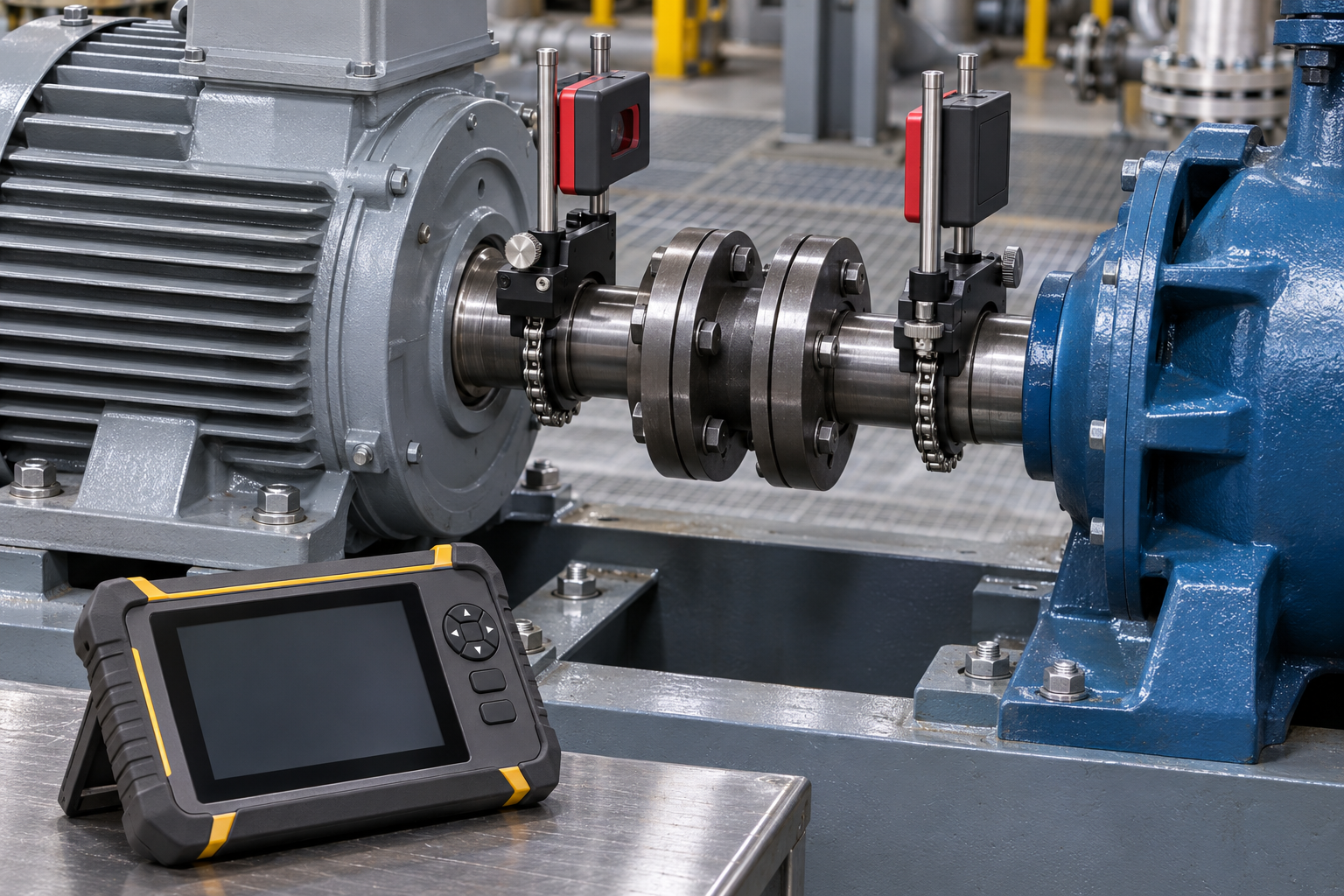
SAMPLE IMAGE 2
MECHANICAL ALIGNMENT VERIFICATION
STATIONARY EQUIPMENT — CONCEPTUAL ONLY Simplified representation of a stationary shaft-alignment assessment. Actual instrument arrangements and alignment procedures depend on the installed equipment.
5. Verify Electrical Readiness Before Energization
Electrical readiness involves more than establishing that the replacement winding has passed its workshop tests.
The motor must also be connected to the plant’s electrical system in accordance with the approved design.
Winding and Insulation Condition
Relevant insulation assessments may be required before energization, particularly after storage, environmental exposure or installation activities.
Insulation resistance measurements can provide useful evidence about selected insulation characteristics.
However, their interpretation depends on the applicable test procedure, winding temperature, test connections and other relevant conditions.
Conventional insulation resistance testing must be carried out under an appropriate de-energized test arrangement, with suitable isolation and post-test discharge precautions.
Connected drives, electronic devices and other equipment must be protected as required by the applicable procedure.
High-voltage withstand and surge tests should not be repeated automatically at the installation site simply because they were included in the workshop repair scope.
Any additional electrical testing must have an appropriate engineering basis.
Power Connections and Earthing
The installed motor should correspond to the approved electrical configuration.
Verification may involve the connection diagram, terminal arrangement, cable identification, connection integrity, earthing and relevant cable-support arrangements.
For medium- and high-voltage machines, cable termination details and required electrical clearances may also deserve particular attention.
Supply Conditions and Starting Method
The supply and starting arrangement must be suitable for the motor and driven equipment.
This may involve direct-on-line starting, reduced-voltage starting, soft starters or variable-frequency drives.
When a motor is operated by a drive, parameters and control requirements affected by the repair or installation should be reviewed by qualified personnel.
Previous drive settings should not automatically be assumed suitable if the relevant machine configuration has changed.
6. Confirm Protection, Control and Interlock Functions
A motor can be mechanically installed and electrically connected while still lacking the protection functions required for safe operation.
Before an authorized restart, the responsible team should establish that the applicable protective and control arrangements are ready.
Depending on the motor and installation, these may include:
- Overload and motor thermal protection
- Short-circuit and earth-fault protection
- Motor differential protection, where applicable
- Starting-time and locked-rotor protection
- Winding and bearing temperature monitoring
- Vibration-related protection, where installed
- Cooling and lubrication permissives
- Emergency-stop and shutdown functions
- Process-related interlocks
Not every motor uses the same protection scheme.
Protection settings must be based on the approved equipment and system requirements, not generic values taken from another installation.
Where relevant, the verification should address the complete protective function, including its inputs, logic and intended alarm or trip response.
A sensor being physically installed does not establish that its associated protection function is working correctly.
Why Protection Should Not Be Bypassed to Meet a Production Schedule
An unavailable or unresolved safety-critical protective function is a reason to reassess restart readiness.
Applicable protection requirements must not be bypassed merely to complete a startup or meet a production deadline.
The appropriate response is to resolve the issue through the authorized engineering and plant safety process.
7. Check Cooling and Auxiliary Systems
The motor may rely on additional systems to maintain its intended operating conditions.
These arrangements differ considerably between machine designs.
Depending on the actual equipment, auxiliary readiness may involve:
- External cooling fans or ventilation equipment
- Air ducts and cooling-air passages
- Air-to-water heat exchangers
- Specified cooling-water flow and pressure
- External bearing-lubrication equipment
- Temperature sensors and monitoring connections
- Anti-condensation heaters and their control logic
- Encoders and speed-feedback devices
- Excitation-related equipment for applicable synchronous machines
Each system should be evaluated according to its function and relationship with the motor.
For example, a separately powered cooling fan may be essential to maintaining acceptable motor temperatures during particular operating conditions.
Similarly, the control arrangement for an anti-condensation heater should follow the machine’s requirements rather than one universal operating rule.
Cooling and auxiliary systems are part of the equipment’s operating readiness, not secondary details to be checked only after a problem occurs.
8. Verify the Driven Equipment and Process Conditions
An industrial motor rarely operates in isolation from the production system.
It may drive a pump, compressor, fan, mill, conveyor or another process machine.
Even if the motor itself is suitable for operation, the complete system may not be ready for the intended start.
The relevant process and mechanical teams should confirm that the driven equipment is prepared according to its applicable requirements.
This may include reviewing mechanical restrictions, required process conditions, lubrication, valve arrangements, loading conditions and other dependencies.
These checks must be specific to the driven equipment.
A starting condition suitable for one pump or compressor design may be inappropriate for another.
The motor must also suit the required direction of rotation.
Direction verification should be conducted only through the approved commissioning method, with appropriate safeguards and consideration of the driven equipment and any direction-sensitive cooling arrangements.
Motor Return-to-Service Readiness Matrix
The following matrix provides a practical framework for organizing the pre-start review.
It is not a universal commissioning procedure or authorization form.
| Readiness Area | What to Verify | Possible Supporting Evidence |
|---|---|---|
| Repair handover | Completed scope and outstanding requirements | Repair documentation and test records |
| Receiving condition | Transport, storage and preservation condition | Receiving inspection and any required follow-up checks |
| Mechanical installation | Foundation, alignment, coupling and guarding | Installation checks and alignment records |
| Bearing and lubrication | Specified lubrication and required supply arrangements | Lubrication checks and auxiliary-system records |
| Electrical readiness | Connections, insulation condition, earthing and supply suitability | Applicable site electrical verification records |
| Protection and controls | Required protective functions, settings and interlocks | Approved settings and functional verification records |
| Cooling and auxiliaries | Availability of required support systems | Relevant functional checks |
| Driven equipment | Mechanical and process readiness | Equipment-specific readiness confirmation |
| Restart authorization | Safety requirements, responsibilities and commissioning plan | Authorized pre-start release and approved work procedures |
The actual readiness checks, documentation and approval responsibilities should be established for the particular machine, plant and repair project.
9. Establish a Clear Go/No-Go Decision Before Restart
A pre-start review becomes more effective when each important finding leads to a clear decision.
Completing most checklist items should not automatically outweigh one unresolved safety-critical requirement.
GO — Ready for Authorized First Start
The applicable pre-start requirements have been satisfied, the necessary records are available, and the designated personnel have authorized the next commissioning activity.
HOLD — Further Clarification Required
An unresolved question, missing record or outstanding assessment requires review before readiness can be established. The machine remains on hold until the matter is appropriately resolved.
NO-GO — Restart Not Authorized
A required safety condition, critical protection function or other mandatory technical requirement has not been satisfied. Restart must not proceed until the issue has been resolved through the approved process.
These categories are an illustrative decision framework, not a substitute for the plant’s actual authorization system.
Authorization for a controlled first start is also different from authorization for unrestricted production operation.
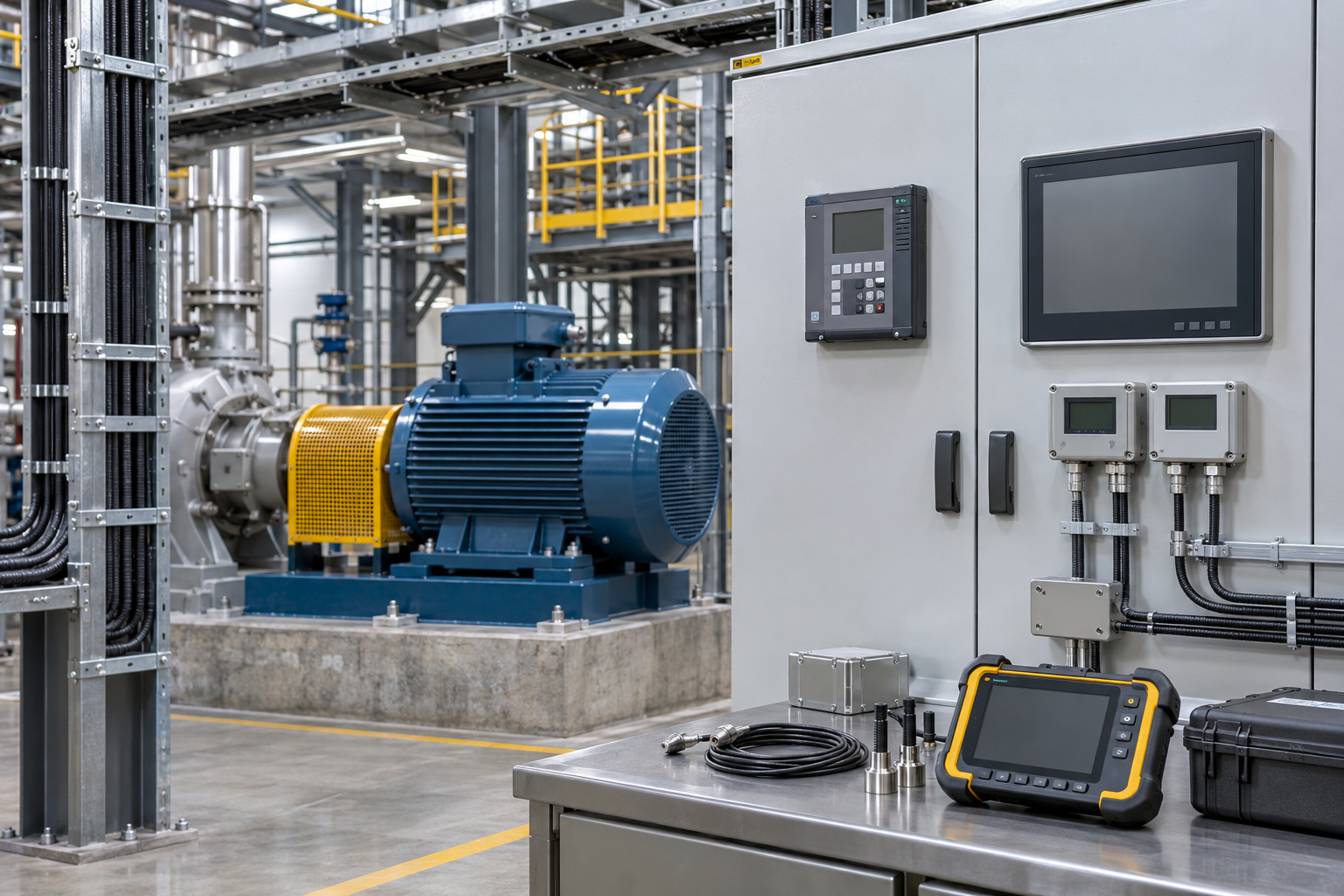
SAMPLE IMAGE 3
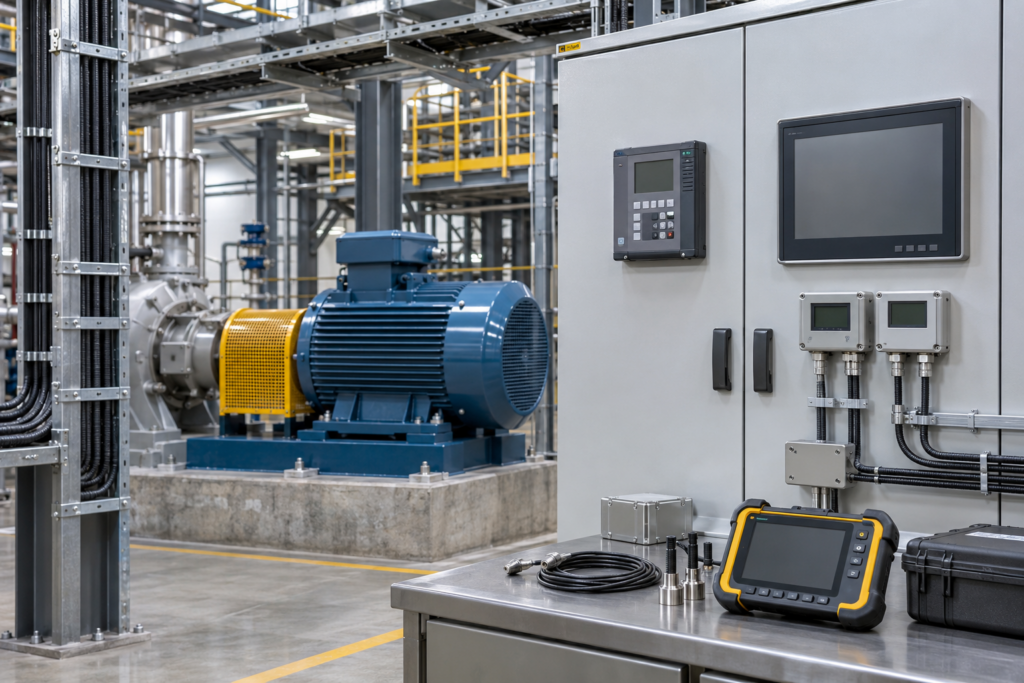
CONTROLLED STARTUP AND COMMISSIONING
ILLUSTRATIVE ONLY — NOT ACTUAL MACHINE DATA Conceptual illustration of an industrial motor and monitoring equipment. The displayed line is illustrative and does not represent actual operating measurements or a successful commissioning result.
10. Plan the First Start as a Controlled Commissioning Activity
The initial restart should be treated as a defined engineering activity rather than an informal trial.
Before energization, the responsible personnel should establish the approved starting arrangement, expected observations, acceptance requirements and response to abnormal conditions.
The appropriate commissioning activities depend on the machine and driven equipment.
Applicable energy-control procedures, personnel clearance, guarding and safety authorization must be addressed before the start.
Where an abnormality requires physical inspection or further adjustment, the equipment must be returned to the appropriate safe condition before work resumes.
What Should Be Observed During the First Run?
Depending on the installed instrumentation and approved commissioning plan, relevant observations may include:
- Starting behavior and acceleration
- Motor current and supply conditions
- Direction and operating speed
- Mechanical vibration
- Unusual noise or operating behavior
- Bearing and winding temperatures
- Cooling and lubrication conditions
- Protection alarms or trip events
- Driven-equipment behavior
These observations must be evaluated against the requirements established for the equipment.
Numerical limits for vibration, temperature, starting time and other parameters should come from the applicable technical basis.
They should not be copied from an unrelated machine simply because it has a similar power rating.
Is an Uncoupled Run Always Necessary?
No.
An uncoupled or no-load run may be appropriate for some commissioning arrangements, but it is not suitable or required in every application.
Some machines have bearing, cooling, shaft-loading or process-related requirements that affect the permissible test configuration.
For example, particular bearing arrangements may require specified axial loading or auxiliary-system operation.
The approved commissioning plan should determine whether an uncoupled, coupled or other operating test is appropriate.
What If the Motor Trips During the First Start?
A protective trip should be treated as information requiring investigation, not merely an interruption to the schedule.
The relevant event records should be preserved, and the condition that caused the protective operation should be evaluated before another start is authorized.
Repeated restart attempts can introduce additional thermal or mechanical stress.
The machine’s permissible starting duty and applicable operating requirements must be respected.
Restarting a Motor Is Not the Same as Releasing It for Production
A motor may complete an initial commissioning run without having operated under all the conditions associated with its intended production duty.
Where applicable, further verification may be needed as operating conditions change.
Before routine service is authorized, the responsible team should review the relevant commissioning findings, unresolved observations and any remaining operating restrictions.
Once the machine reaches a suitable and stable operating condition, appropriate measurements can be retained as baseline information for later reliability monitoring.
This creates a useful connection between repair acceptance, site commissioning and the machine’s future maintenance history.
Three Practical Return-to-Service Scenarios
Scenario A: The Workshop Tests Are Acceptable, but Alignment Is Outstanding
A rewound motor has returned to the plant with satisfactory results for the specified workshop electrical tests.
However, the final alignment with its driven equipment has not been verified.
The winding repair may be accepted within its scope, but installed-system readiness remains incomplete.
Scenario B: The Motor Is Installed, but a Required Protective Function Is Unavailable
The repaired motor has been mounted, connected and mechanically checked.
A required bearing-temperature protection function has not been demonstrated.
The unresolved protective requirement must be addressed before restart can be authorized.
Scenario C: The Motor Completes a Controlled First Run
The agreed readiness checks have been addressed and the motor completes its authorized initial run.
Relevant observations are reviewed against the commissioning requirements.
Further operating verification and formal release may still be required before normal production resumes.
These scenarios are hypothetical educational examples, not records of actual Kamol Engineering projects.
Final Motor Pre-Start Checklist
Before an authorized restart, the responsible engineering, maintenance and operations teams can consider the following questions:
- Does the repair documentation match the actual machine and agreed work?
- Has the motor’s condition after transport and storage been addressed?
- Are the foundation, alignment and mechanical installation suitable?
- Are the bearings and required lubrication systems ready?
- Have the applicable electrical checks been completed?
- Are required protection, control and interlock functions available?
- Are the relevant cooling and auxiliary systems ready?
- Is the driven equipment prepared for the intended starting condition?
- Are hazardous-energy controls, guarding and personnel safety requirements addressed?
- Is there an approved first-start and commissioning plan?
- Have unresolved technical findings been appropriately addressed?
- Has restart been authorized by the designated responsible personnel?
This checklist supports engineering review. It does not replace the equipment manufacturer’s instructions, site safety procedures or authorized commissioning documentation.
Return-to-Service Readiness Is a Shared Responsibility
The repair provider may be responsible for completing and verifying the agreed workshop scope.
The installation team may be responsible for mechanical and electrical installation activities.
The plant’s engineering, safety, commissioning and operations personnel may have additional responsibilities before the machine is released for operation.
The exact division of responsibility depends on the contract and project arrangements.
What matters is that important activities are identified and assigned rather than assumed to have been completed by another party.
A motor can satisfy its individual repair requirements while the complete operating system still needs further verification.
Repair Completion Is Not the Final Readiness Decision
A repaired motor represents an important step toward restoring production.
But the final objective is not simply to return the machine to the plant or demonstrate that it can rotate.
The objective is to establish that the repaired motor can enter its authorized operating duty within a suitably verified installation.
Electrical condition, mechanical alignment, lubrication, protection, cooling and driven-equipment readiness all contribute to that decision.
A successful repair is a milestone. A justified return-to-service decision connects that repair with the actual conditions the motor will experience in operation.
Discuss Industrial Motor Rewinding and Electrical Testing With Kamol Engineering
Kamol Engineering Services Co., Ltd. provides stator and rotor rewinding, coil manufacturing and electrical testing services for industrial motors and generators.
When planning a motor repair project, customers should discuss the applicable inspection requirements, workshop tests, documentation and handover conditions as part of the agreed scope.
Useful information for a technical enquiry includes:
- Motor nameplate and application
- Reported failure symptoms
- Available inspection and test records
- Repair or winding requirements
- Expected operating conditions
- Required verification and handover documentation
- Relevant shutdown and installation constraints
Share the available technical information to support a focused discussion of your motor repair requirements.
Any site installation, alignment, protection-system verification or commissioning service should be confirmed separately as part of the agreed project responsibilities.
Explore Stator Rewinding Explore Electrical Testing Contact Kamol Engineering
Frequently Asked Questions
What should be checked before restarting a repaired industrial motor?
Relevant checks include repair documentation, receiving condition, mechanical installation, alignment, lubrication, electrical connections, protection systems, cooling, driven-equipment readiness and authorized commissioning requirements.
Can a repaired motor be started immediately after passing workshop tests?
Not automatically. Workshop testing verifies selected characteristics within the repair scope. The installed machine and its associated systems must also satisfy the applicable pre-start requirements.
Should insulation resistance be checked before restarting a motor?
It may be required by the machine manufacturer, commissioning procedure or equipment condition, particularly after storage or potential moisture exposure. The appropriate de-energized test method and evaluation criteria must be followed.
Why is shaft alignment important after motor repair?
Appropriate alignment helps manage mechanical loads within the motor and driven-equipment system. Incorrect alignment can contribute to vibration, bearing loading and coupling-related problems.
Should bearing lubrication be checked before a motor starts?
Yes, according to the applicable bearing and lubrication requirements. Different bearing designs may require different verification activities and auxiliary-system conditions before operation.
Does every repaired motor require a no-load site test?
No. The suitable commissioning configuration depends on the motor, bearing arrangement, driven equipment and approved test procedure. An uncoupled run should not be assumed appropriate in every application.
What should happen if a motor trips during commissioning?
The relevant event and protective operation should be investigated. Another start should not be attempted until the condition has been appropriately evaluated and the restart authorized under the applicable procedures.
Does passing a first run prove that the motor is ready for full production?
No. An initial run may evaluate only selected operating conditions. Further commissioning checks, operating verification and formal release may be required before routine production.
What is the difference between motor commissioning and condition monitoring?
Commissioning evaluates the installed equipment against defined requirements during its preparation and initial operation. Condition monitoring evaluates selected characteristics during continued service.
Who is responsible for approving a repaired motor’s return to service?
Approval should follow the plant’s designated engineering, safety and operations responsibilities, together with the applicable contract and commissioning procedures. Workshop release alone does not automatically constitute site authorization.
Technical note: This article provides general educational guidance on industrial motor return-to-service readiness, informed in part by EASA repair guidance and the commissioning principles described in the ABB Manual for Induction Motors and Generators. It is not a machine-specific startup procedure, protection-setting guide or authorization to energize equipment. Actual requirements must follow the applicable manufacturer instructions, approved engineering documents, local safety requirements and site procedures. All sample graphics and scenarios are conceptual and do not represent actual Kamol projects, measured results or completed commissioning activities.