What Evidence Should Engineers Capture After a High-Voltage Motor Failure?
The motor has tripped. Production is waiting for an answer, and the maintenance team is already discussing how quickly the machine can be repaired.
But before the first component is removed, there is a question worth asking
What evidence could disappear once disassembly begins?
A failed motor rarely tells its full story through one damaged component.
A winding may show severe overheating, but that does not automatically explain what caused it. The investigation may also need to consider the power supply, loading conditions, cooling system, protection settings and previous operating history.
The same applies to mechanical damage.
A damaged bearing may explain why the motor stopped, while lubrication, alignment, contamination or external mechanical loads still need to be considered as possible contributing factors.
These are investigation possibilities, not diagnoses of a particular motor.
Once disassembly begins, important details may change. Cable arrangements may be disturbed. Deposits may be removed. Contact marks may disappear. The original position of damaged components may no longer be clear.
A well-documented starting condition helps engineers distinguish between what was actually observed and what is only suspected.
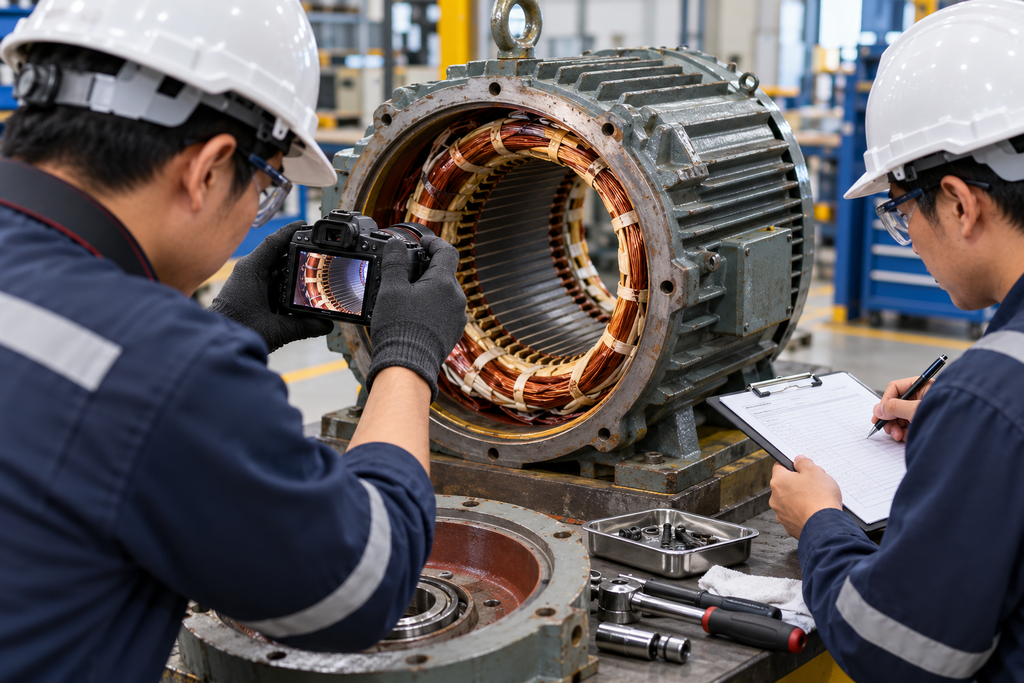
Safety Comes Before Evidence Collection
A failed high-voltage motor must be treated as potentially hazardous until the necessary safety controls have been completed.
Follow the plant’s approved electrical safety procedures, isolation requirements, lockout/tagout arrangements and applicable permits.
Only authorized, competent personnel should perform physical inspections or electrical testing.
Useful information may already be available through protection relays, plant monitoring systems and maintenance records. Where authorized, these records can be reviewed without physically opening the motor.
Never disturb damaged equipment or attempt additional testing simply to complete an evidence checklist.
Six Types of Evidence Worth Preserving
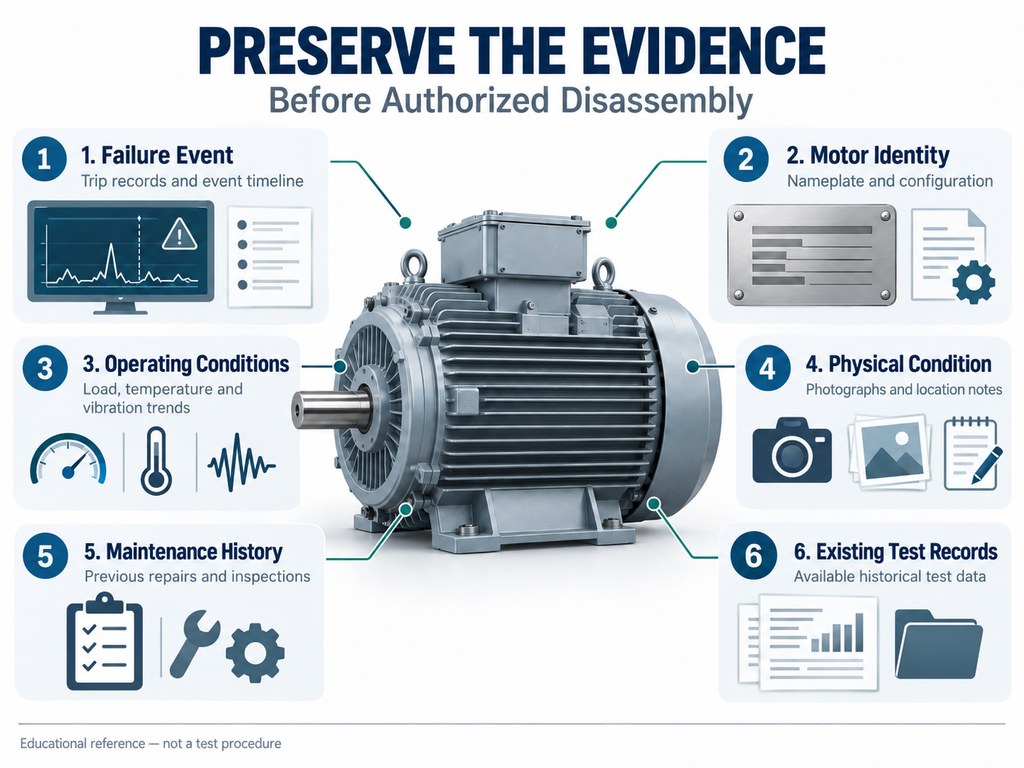
A useful investigation connects three things: what happened during operation, what the equipment looks like afterward, and what its history tells us.
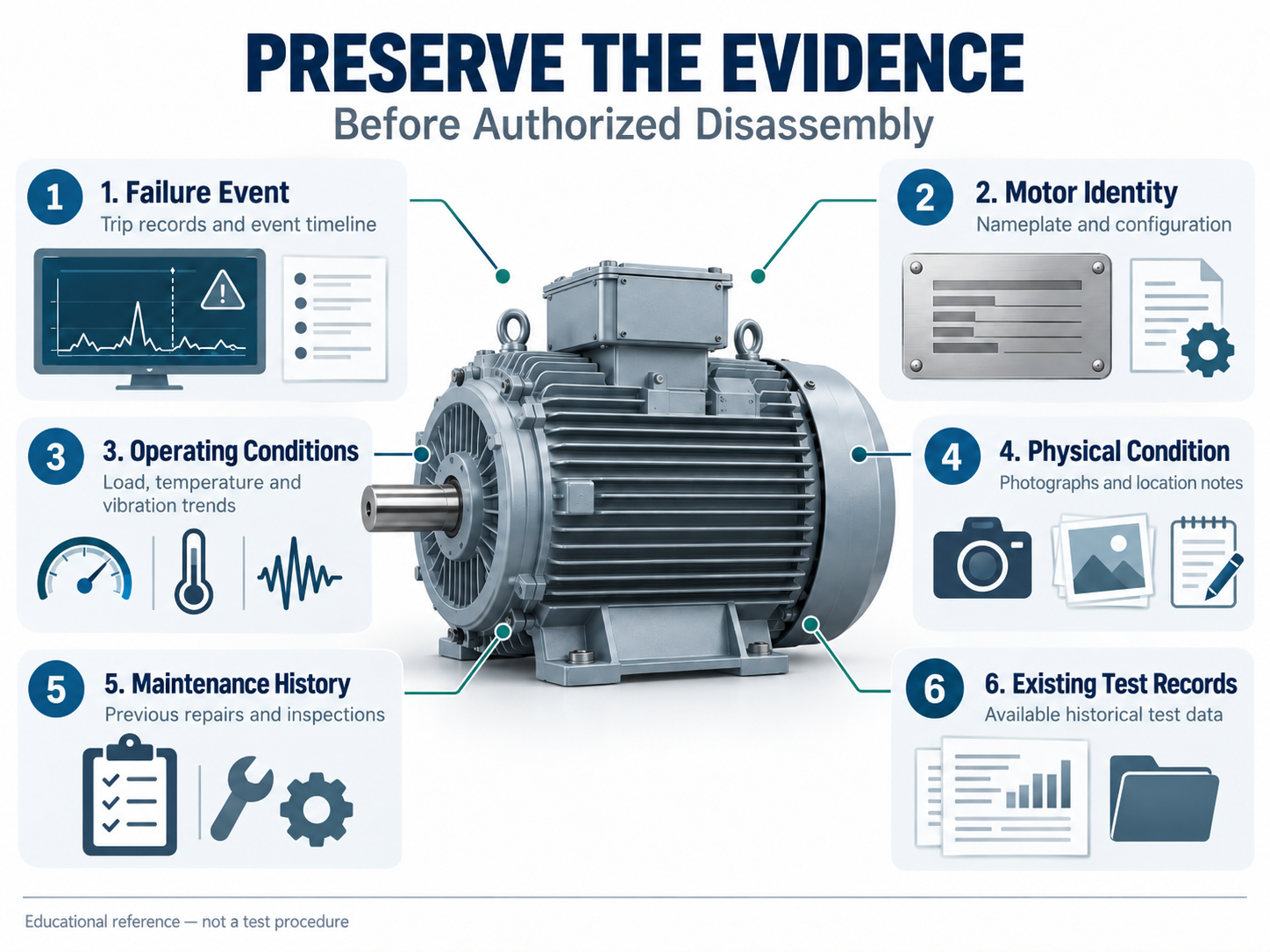
The following six evidence categories provide a practical starting point.
Not every record will be available for every motor, and the investigation should identify missing information rather than assume it exists.
| Evidence Category | What to Preserve | Why It Matters |
|---|---|---|
| 1. Failure Event | Trip time, alarms, protection records and event sequence | Helps establish the circumstances of the shutdown |
| 2. Motor Identity | Nameplate, equipment ID, configuration and relevant drawings | Identifies the motor and its operating arrangement |
| 3. Operating Conditions | Available load, current, voltage, temperature and vibration trends | Provides context for possible electrical, thermal or mechanical stresses |
| 4. Physical Condition | Safely obtained photographs, component positions, visible damage and deposits | Preserves physical observations before conditions change |
| 5. Maintenance History | Previous repairs, inspections, abnormalities and recent modifications | Helps identify recurring issues or relevant changes |
| 6. Existing Test Records | Historical electrical and mechanical inspection or test results | Provides previous evidence for comparison and further assessment |
1. Record What Happened When the Motor Failed
Start with the event itself.
What time did the motor trip? Which protective device operated? Were there alarms before the shutdown? Was the motor starting, running normally or responding to a process change?
Protection relay records and alarm histories can help reconstruct the sequence.
But a trip indication is not necessarily a root-cause diagnosis.
For example, an overcurrent indication establishes that the protection system detected a particular electrical condition. It does not, by itself, establish what initiated that condition.
Speak with operators or maintenance personnel who witnessed the event. Ask what they actually observed, not what they think must have happened.
Keep recorded facts separate from personal interpretations.
Where possible, preserve original event files and timestamps rather than relying only on manually copied values.
2. Preserve Motor Identity and Operating Context
Record the nameplate and equipment identification before the information becomes difficult to access.
Relevant details may include:
- Manufacturer, model and serial number
- Rated voltage, power, current and speed
- Frequency and relevant connection details
- Equipment identification and driven application
- Relevant drawings and operating configuration
The wider operating system matters too.
Is the motor supplied directly from the electrical network or through a variable frequency drive (VFD)? What equipment does it drive? Were there recent changes in process demand or operating conditions?
Available current, voltage, temperature and vibration trends may help establish the conditions surrounding the failure.
An abnormal trend may point toward an area requiring investigation. It should not be treated as proof of a specific failure mechanism without supporting evidence
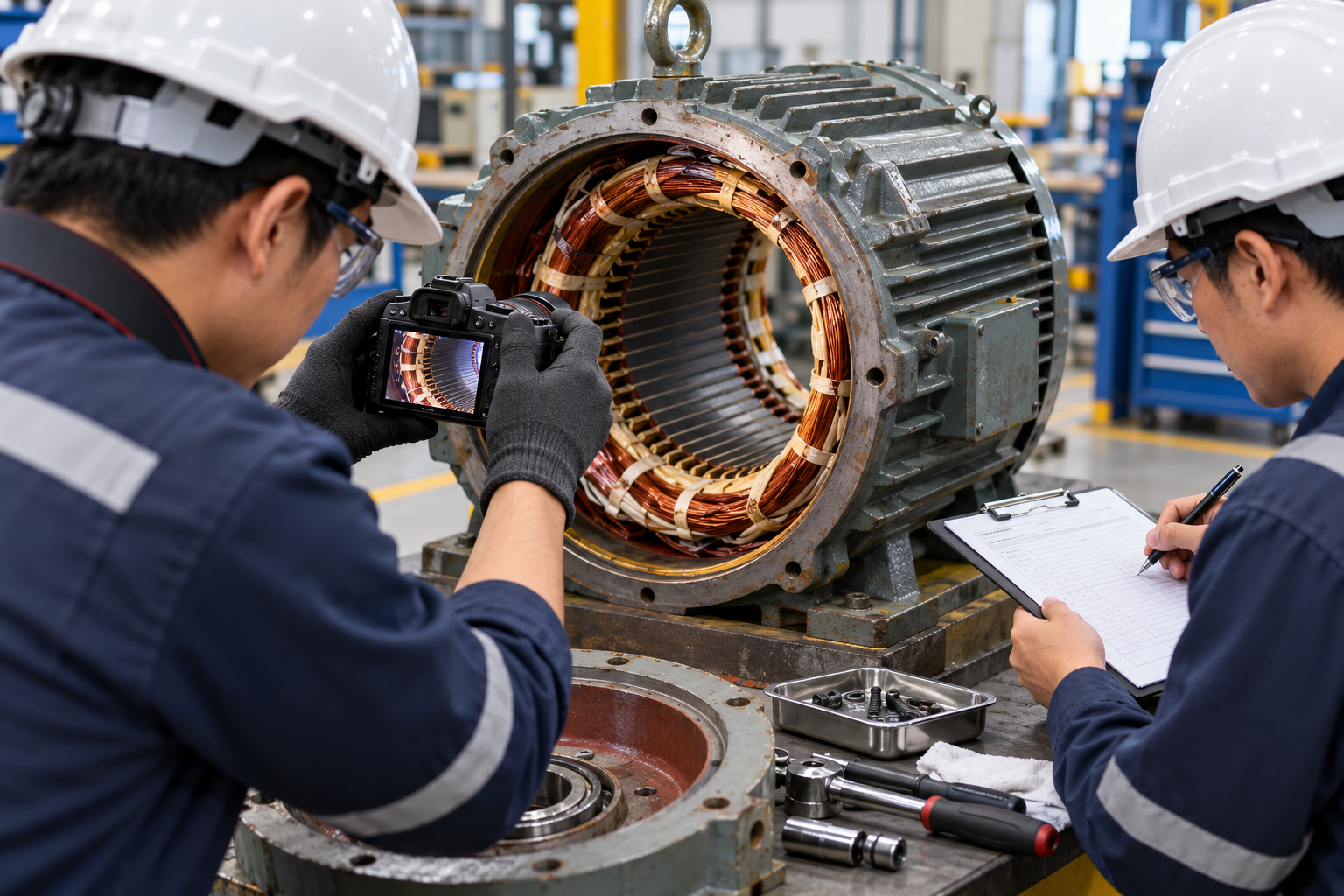
Photograph the Condition Before It Changes
Good photographs do more than show damage.
They preserve the relationship between the damaged area, surrounding components and the motor’s original arrangement.
Where safe access has been authorized, begin with an overall view showing the equipment and its location.
Then capture relevant details, such as:
- Visible damage and its location
- Signs of overheating or contamination
- Accessible terminal and connection arrangements
- Relevant bearing or mechanical conditions
- Component position, orientation and identification marks
Identify the drive end and non-drive end where relevant. Record the viewing direction so that another engineer can understand what the photograph shows.
Photographs should be dated and linked to the equipment identification.
Do not open enclosures, remove guards or disturb components solely for a photograph unless the activity is authorized and the required safety controls are in place.
As authorized disassembly progresses, photograph each relevant stage before the next action changes the evidence.
This preserves information without implying that all internal components were accessible before teardown.
4. Retrieve Maintenance History and Existing Test Results
The motor’s history may reveal details that its damaged condition alone cannot.
Review available records from previous inspections, maintenance work, repairs and abnormal operating events.
Has the motor tripped before? Were unusual temperatures or vibration levels reported? Was recent work carried out on the motor, coupling, power supply or driven equipment?
Previous electrical test records may also be useful.
For example, historical insulation resistance or winding resistance measurements can provide context when their dates, test conditions and methods are known.
Comparisons must be made carefully. Results recorded under different conditions may not be directly comparable.
Importantly, collecting existing test records is not the same as requiring new tests.
Whether further testing is suitable depends on the motor’s condition, the investigation objective and the associated risks.
A qualified engineer should determine which, if any, additional tests are justified.
Why Burn Marks Are Clues, Not Conclusions
A badly burnt winding attracts attention immediately.
It may show where the damage became severe. It does not necessarily reveal where the failure started.
Possible contributing factors might involve electrical stress, thermal deterioration, cooling problems, abnormal loading or mechanical conditions.
The investigation has to determine which explanations are consistent with the available evidence.
The same caution applies elsewhere.
Contamination may be relevant without necessarily being the initiating cause. A damaged bearing may be the result of another condition rather than the original problem.
Good failure analysis separates observations, possible explanations and the evidence required to support a conclusion.
That distinction matters because an early assumption can influence every decision that follows, including the repair scope.
From Collected Evidence to an Engineering Decision
From Collected Evidence to an Engineering Decision
Once the initial information is organized, the next question should not simply be:
“Can this motor be rewound?”
A more useful set of questions is:
What do we know about the failure? Which possible mechanisms remain credible? What information is still missing? And what assessment is needed before deciding on the repair?
The evidence can be organized into three groups.
Confirmed observations
These include verified operating records, recorded protection events, documented physical findings and other information supported by evidence.
Possible explanations
These are engineering hypotheses that could explain the observed condition. They should remain open to revision as further information becomes available.
Unresolved questions
These include missing records, uncertain failure progression and issues that require additional inspection or analysis.
This structure makes technical discussions more productive.
It also gives operations, maintenance and management a clearer view of what is known before they approve the next step.
Practical Checklist Before Authorized Disassembl
Before the motor is dismantled, review the following where applicable and safe:
- Confirm that approved safety and isolation controls govern the work.
- Preserve the failure timeline and available protection records.
- Record motor identification and relevant configuration details.
- Save available operating and condition-monitoring trends.
- Photograph accessible physical evidence and record its location.
- Retrieve maintenance history and existing test records.
- Identify missing information and agree on the next engineering assessment.
This checklist is intended to support evidence preservation. It is not an authorization for disassembly, energization or electrical testing.
Frequently Asked Questions
Can visible winding damage reveal the root cause?
Not reliably on its own. Visible damage may suggest possible failure mechanisms, but operating conditions, protection records, maintenance history and other evidence are needed to assess the cause.
Should electrical testing always be performed before disassembly?
No. Testing depends on the motor’s condition, the investigation objective and the associated risks. Additional testing should be selected by qualified personnel under an approved investigation plan.
Why are protection relay records important?
They help establish the event sequence and the conditions detected by the protection system. Their interpretation still requires knowledge of the equipment, protection settings and operating circumstances.
Can a motor be repaired without identifying the root cause?
Repair may be technically possible even when the root cause remains uncertain. That uncertainty should be documented and considered when determining the repair scope and any corrective actions.
What information should be sent to an engineering repair partner first?
Start with the motor nameplate, application, failure timeline, available trip records, safely obtained photographs and relevant maintenance history. Include existing test records where available and identify any missing information.
A Better Repair Decision Starts Before Teardown
When a critical motor fails, there is understandable pressure to move quickly.
Preserving the initial evidence helps the engineering team avoid losing information that may be difficult or impossible to recover later.
The aim is not to collect every possible measurement. It is to retain enough reliable information to understand the failure context, assess possible mechanisms and determine a defensible next step.
If your team is reviewing a failed high-voltage motor, you can start an engineering enquiry with Kamol Engineering Services Co., Ltd.
Share the available nameplate details, failure symptoms, photographs and existing records to help establish the scope of the initial technical discussion.
*A better repair decision begins with understanding what is known — and what still needs to be investigated.
Engineering References
- Electrical Apparatus Service Association (EASA).
Tom Bishop, PE. A “How To Guide” for Root Cause Failure Analysis. July 2013.
https://easa.com/resources/resource-library/article/a-how-to-guide-for-root-cause-failure-analysis - EASA.
The Importance of Root Cause Failure Analysis. December 2010.
https://easa.com/resources/resource-library/the-importance-of-root-cause-failure-analysis-1 - U.S. Occupational Safety and Health Administration (OSHA).
The Control of Hazardous Energy (Lockout/Tagout).
https://www.osha.gov/laws-regs/regulations/standardnumber/1910/1910.147
These references support general engineering and hazardous-energy-control principles. Actual work must follow the applicable local requirements and approved site procedures. The references do not imply Kamol certification or compliance with any particular standard.