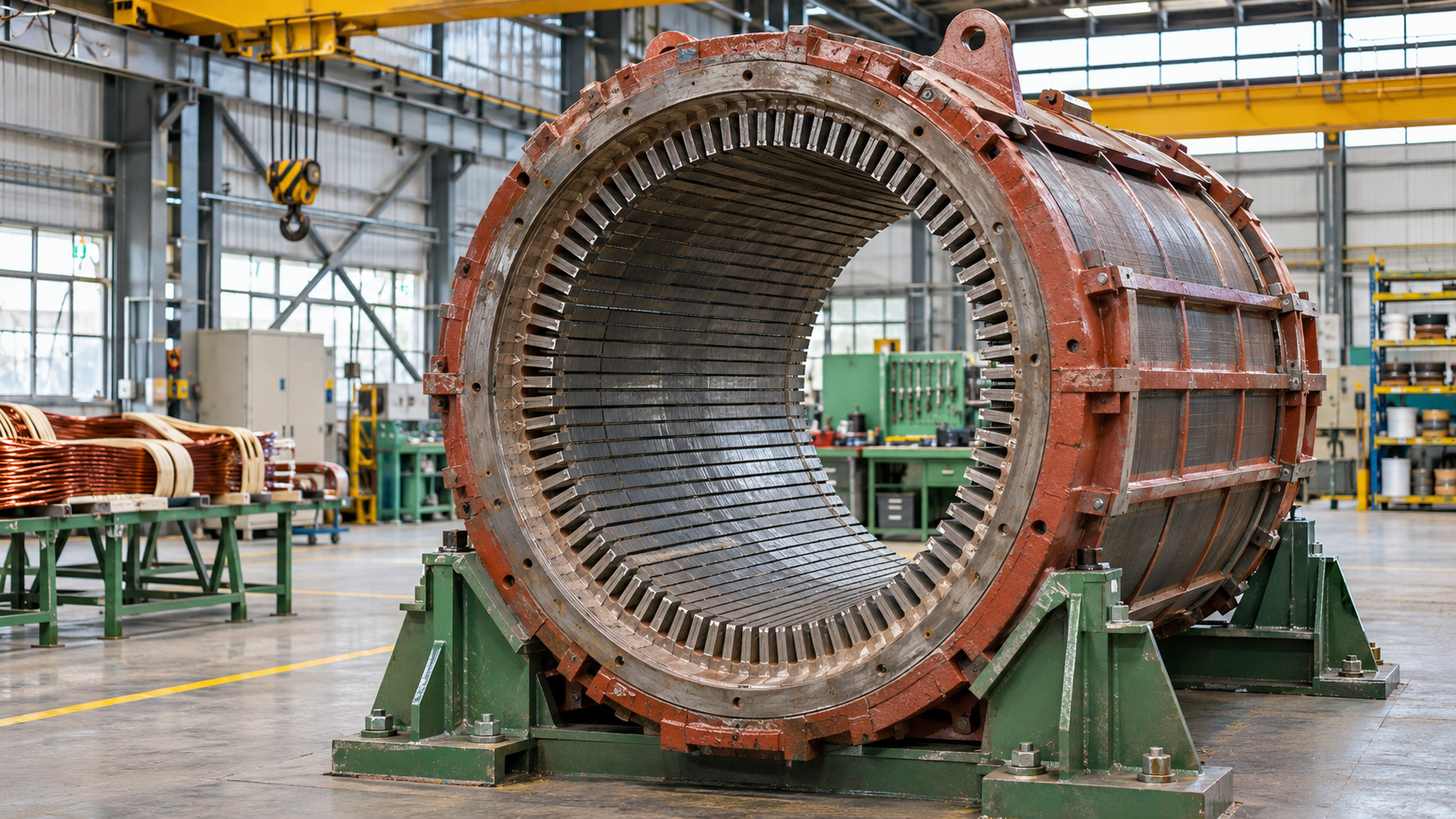
Stator Core Condition Before Rewinding: What Engineers Need to Check
The damaged winding has been identified, and the repair team is preparing for a stator rewind.
At first, the next step may seem obvious: remove the old winding, prepare the slots and install the replacement coils.
But there is another part of the machine that deserves attention before the new winding goes in.
The stator core.
A new winding can be manufactured to the correct dimensions and installed with suitable insulation. However, if the underlying core has damaged laminations, unsuitable slot surfaces or other unresolved defects, replacing the winding alone may not address the complete repair requirement.
Core-related defects can affect magnetic losses, localized heating, winding insulation and the mechanical condition of the assembly.
Before rewinding, engineers need evidence that the stator core is suitable for the proposed repair—not simply that the old coils have been removed.
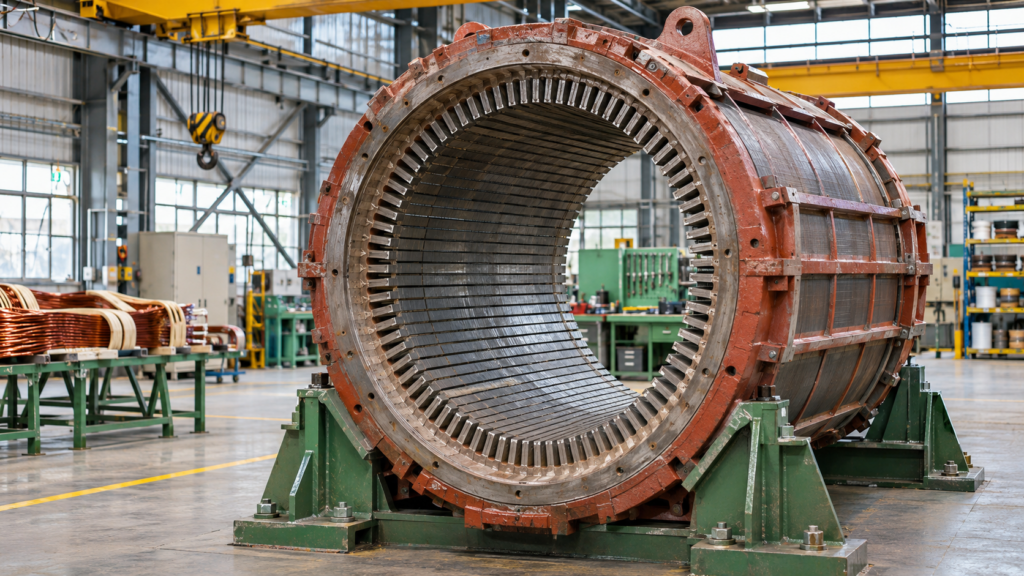
Why Does Stator Core Condition Matter During Rewinding?
The stator core is a major part of the magnetic circuit of an electrical machine.
In many AC motors and generators, it is built from thin electrical-steel laminations rather than one solid steel block.
The laminated construction helps control eddy-current losses during operation.
The insulation between adjacent laminations is therefore important. If it is damaged and electrical contact develops between laminations, unwanted circulating currents may produce additional losses and localized heating.
Depending on the severity and location, these conditions may affect nearby winding insulation or the suitability of the core for continued service.
Core condition also includes mechanical features. Damaged teeth, distorted slots, looseness or other structural problems can affect winding installation and support.
For this reason, a winding replacement should not be treated as proof that the stator assembly is ready for service.
What Is Interlaminar Insulation?
Interlaminar insulation is the insulating separation between the steel laminations that form the core.
Its purpose is different from the insulation used around the copper winding.
The winding insulation separates conductors from one another and from grounded structures according to the winding design. Interlaminar insulation helps limit unwanted electrical currents between the steel sheets of the magnetic core.
Both are important, but they address different parts of the electrical machine.
1. Look for Visible Lamination Damage
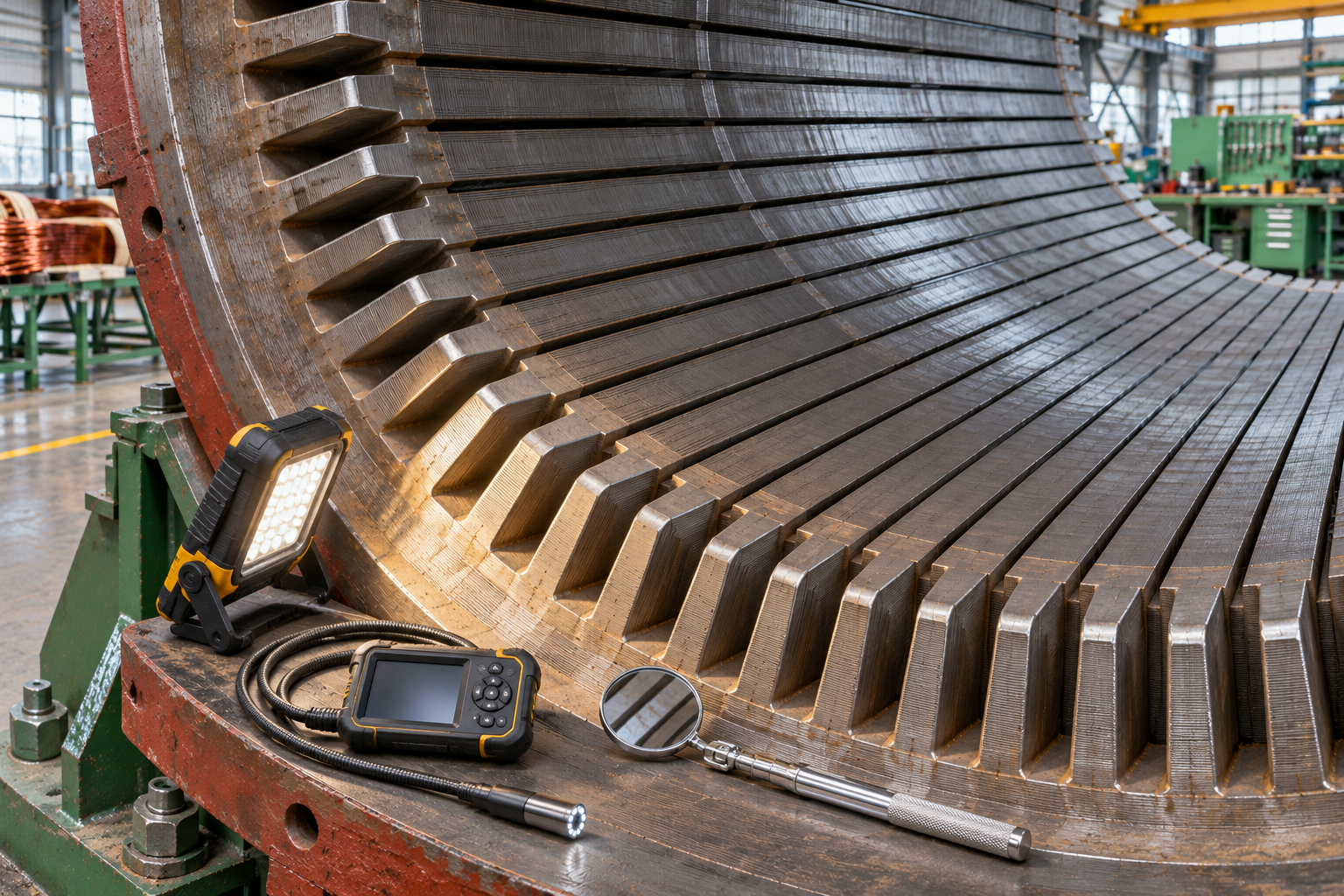
Visual inspection is a useful starting point for assessing accessible stator-core surfaces.
It may reveal conditions that deserve closer examination, including:
- Burn marks or localized discoloration
- Physical damage at slot edges
- Burrs or displaced laminations
- Deformed or damaged core teeth
- Corrosion, contamination or foreign material
- Evidence of rubbing or mechanical contact
- Signs of previous repairs or unusual surface treatment
However, visual appearance alone cannot establish the electrical condition of the interlaminar insulation.
Some defects may be concealed, and not every discolored area represents the same failure mechanism.
Photographs should identify the location and condition observed, without automatically assigning a cause.
Why a Burn Mark Is Not a Complete Diagnosis
A darkened area near a failed winding can indicate that the region experienced an abnormal event.
But it does not establish whether the core laminations themselves are electrically damaged, whether the damage extends below the visible surface or which event started the failure.
Further examination and suitable testing may be necessary.
2. Examine the Core Teeth and Slot Geometry
The stator slots must be suitable for the winding system that will be installed.
That includes the condition of the core teeth, slot edges and other surfaces that interact with the insulation system and mechanical retaining components.
A slot that has been damaged during a failure or previous repair may affect the fit of a replacement coil.
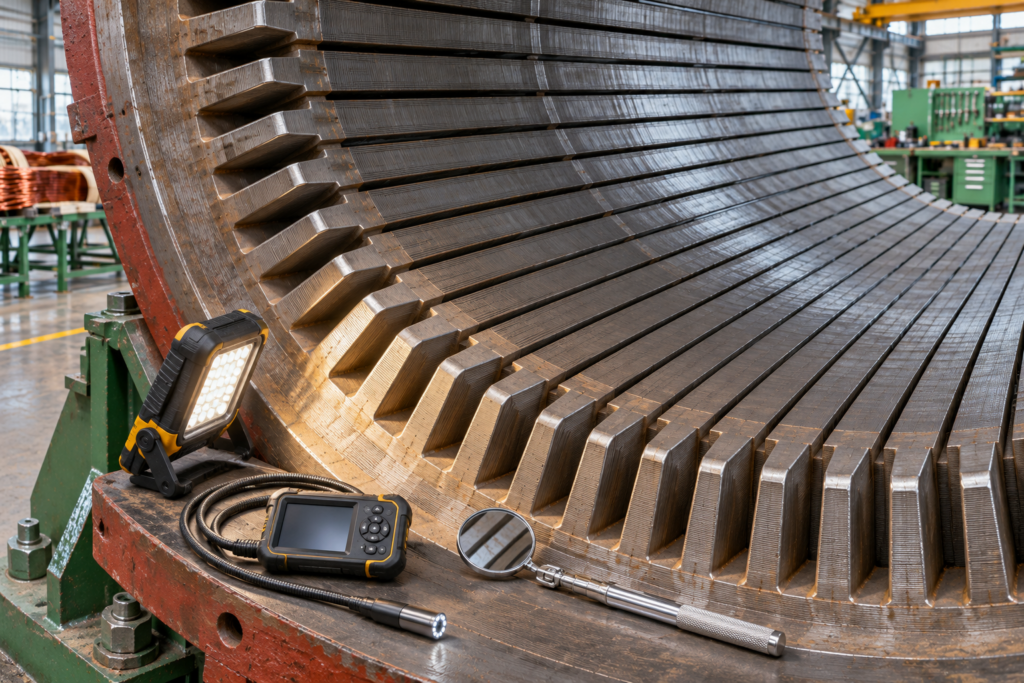
What Should Engineers Check?
Depending on the core design, inspection may include:
- Damaged, bent or displaced teeth
- Sharp edges or burrs that may damage insulation
- Deformation affecting slot dimensions
- Unusual contact between adjacent laminations
- Condition of accessible slot surfaces
- Relevant wedges, spacers and retaining interfaces
These observations should be evaluated against the applicable engineering requirements.
For large form-wound machines, even a local geometric issue can complicate coil installation or insulation protection.
The correct response depends on the defect and the approved repair method.
3. Assess Lamination Tightness and Core Structure
A stator core is a mechanical assembly as well as a magnetic component.
Depending on its construction, laminations may be compressed and retained within a structure that includes clamping components, support features and ventilation passages.
Core looseness, movement or structural damage may deserve investigation before rewinding.
Engineers may need to review:
- Evidence of lamination movement or looseness
- Condition of accessible clamping and support features
- Mechanical damage affecting core alignment
- Ventilation duct or spacer condition, where applicable
- Evidence of movement between the core and frame
- Signs of rubbing or unusual mechanical contact
Not every stator has the same construction, and not every feature can be evaluated by visual inspection.
Mechanical findings should be reviewed in the context of the actual machine design.
4. Consider Core Damage During Winding Removal
Core assessment is especially important because removal of a damaged winding can itself introduce risks to the laminated structure.
Depending on the machine and stripping method, those risks may involve excessive heating, unsuitable mechanical force, damage from cutting tools or accidental contact with slot surfaces.
The removal procedure should therefore be selected to protect the remaining machine components.
Why Temperature Control Matters
Some winding-removal methods involve controlled heating.
Excessive or unsuitable thermal exposure can affect interlaminar insulation and the condition of the stator frame.
The applicable temperature limits and procedures depend on the core construction, materials and approved repair specification.
It would be inappropriate to apply one temperature limit to every stator without confirming the machine and material requirements.
Why Core Inspection Should Not Begin Only After Stripping
Where practicable and technically appropriate, an assessment before winding removal can provide a valuable comparison with the condition after removal.
This helps answer two different questions:
- What was the core condition before the removal process?
- Did the removal and preparation work change that condition?
If a reliable baseline cannot be obtained, that limitation should be documented rather than assuming that the original core condition was acceptable.
5. Understand Stator Core Testing Methods
Visual inspection is not always sufficient to evaluate the electrical condition of the laminated core.
Specialized core tests may be used to investigate interlaminar insulation problems, magnetic losses or localized heating.
Two commonly discussed approaches are the high-flux loop or ring test and the low-flux electromagnetic core imperfection detection method, often called EL CID.
These methods operate differently. Their results are not automatically interchangeable.
High-Flux Loop or Ring Test
A loop test uses an external excitation arrangement to establish magnetic flux in the stator core.
Depending on the selected procedure, engineers may assess core losses and look for abnormal localized temperature rise.
Potential hot spots can provide evidence requiring further examination.
Because the test involves substantial electrical energy and induced voltages, it requires competent personnel, suitable equipment and a controlled test arrangement.
Test flux, frequency, temperature measurement method, test duration and other conditions can influence the results.
A comparison between two core-loss tests may therefore be unreliable if the test conditions are not sufficiently comparable.
Low-Flux EL CID Testing
Electromagnetic Core Imperfection Detection, or EL CID, uses a relatively low level of magnetic excitation.
The method looks for electromagnetic evidence associated with circulating currents caused by interlaminar insulation defects.
It can be useful for locating regions that warrant additional assessment.
However, EL CID results require skilled interpretation.
A signal is not, by itself, a direct measurement of the temperature that the same region would reach in normal operation.
Different defect geometries, core conditions and test arrangements can affect the relationship between a detected signal and the operational consequences of a fault.
Low-flux testing also has limitations. It should not be described as a guarantee that every core defect will be identified.
Can EL CID Replace a High-Flux Test?
The appropriate selection depends on the machine, inspection objective, access, applicable standard and engineering assessment.
In some circumstances, one method may be selected as the principal examination. In other circumstances, additional testing or investigation may be necessary to understand a particular finding.
There is no reason to claim that every stator must undergo both tests or that one test always proves the same condition as the other.
SAMPLE IMAGE 2 — CORE LAMINATION & SLOT INSPECTION Suggested close-up: accessible stator-core laminations, tooth edges and slot surfaces being examined before replacement winding installation. Illustrative only.
Stator Core Inspection: A Practical Checkpoint Matrix
The following table summarizes areas that may require attention. It is an educational decision aid, not a universal acceptance standard.
| Inspection Area | What to Look For | Engineering Question |
|---|---|---|
| Laminations | Damage, burrs, displaced steel or discoloration | Is further interlaminar evaluation required? |
| Core teeth | Deformation, fractures or damaged edges | Can the winding be installed safely with the intended geometry? |
| Slots | Surface damage, contamination and dimensional irregularities | Will the slot surfaces and dimensions suit the approved insulation system? |
| Core stack | Visible looseness or movement, where accessible | Does the mechanical condition require further assessment? |
| Ventilation passages | Obstruction or damage, where applicable | Are the relevant cooling paths and structures suitable? |
| Magnetic core condition | Relevant loss, temperature or electromagnetic test indications | Do the findings require investigation or corrective work? |
| Post-removal condition | Changes compared with earlier records | Was any core condition affected during stripping and preparation? |
Engineering note: Actual inspection points and acceptance criteria must be selected for the machine, test method and applicable repair requirements.
6. Compare Core-Test Results Carefully
Core testing is often most useful when it allows an informed comparison between relevant stages of repair.
But a change in recorded losses or apparent hot spots should not be interpreted without reviewing how the measurements were obtained.
For example, the following factors can affect comparison:
- Magnetic flux level
- Excitation frequency
- Core and ambient temperatures
- Test duration
- Instrumentation and calibration
- Sensor location and measurement technique
- Differences in the machine or test configuration
When comparing before-and-after measurements, engineers should establish whether the test conditions support a meaningful comparison.
If the conditions differ significantly, the result may need further analysis or an additional test under an appropriate procedure.
Does a Higher Core-Loss Reading Always Mean the Core Is Damaged?
Not automatically.
An increase may require investigation, but the quality of the comparison must be checked before assigning the cause.
Core-loss results may be influenced by the test arrangement as well as the core condition.
The purpose of a good test report is to provide the information needed for responsible interpretation.
7. Review Findings Before Authorizing Core Repair
If a core defect is suspected or confirmed, the next step is to determine what work is technically appropriate.
Depending on the damage and construction, this could require local investigation, an approved corrective procedure or more extensive engineering evaluation.
Severe or widespread damage may affect the feasibility of the planned rewind.
The appropriate response should be based on the actual defect, core design and applicable repair specification.
There is no universal surface treatment that resolves every interlaminar or structural defect.
What Should Be Verified After Corrective Work?
When work has been performed on the core, relevant inspections or tests should be used to assess the result.
The required verification depends on what was repaired and the acceptance requirements.
A visually improved surface does not automatically prove that the magnetic or mechanical condition has been restored.
Likewise, the absence of an obvious hot spot in one test does not establish that every possible defect has been eliminated.
8. Keep Core Inspection Separate From Winding Insulation Testing
This distinction is important during technical discussions.
Core testing and winding insulation testing evaluate different parts of the machine.
An insulation resistance test can provide information about the winding insulation system under the applicable test conditions.
A core-loss or interlaminar insulation assessment is directed toward the condition of the magnetic core.
Passing a winding insulation resistance test does not prove that the stator core is free from shorted laminations.
Similarly, an acceptable core-test result does not prove that a replacement winding has passed all of its required electrical tests.
The repair plan should specify which questions each inspection or test is intended to answer.
What Should Be Included in a Core Inspection Report?
For a critical stator, a useful technical report should help the customer understand what was examined, what was found and which decisions follow from the results.
Depending on the inspection scope, it may include:
- Machine identification and core description
- Inspection stage and condition of the winding at the time
- Photographs identifying relevant locations
- Observed lamination, tooth and slot conditions
- Test methods and applicable procedures
- Recorded test conditions and results, where applicable
- Comparison with available baseline or previous results
- Abnormal indications requiring investigation
- Engineering disposition and proposed corrective work
- Verification performed after any core repair
- Limitations, exclusions and unresolved questions
Records should distinguish measured results from interpretations and recommendations.
Where tests were not performed, their absence should be clear rather than implied to have been satisfied.
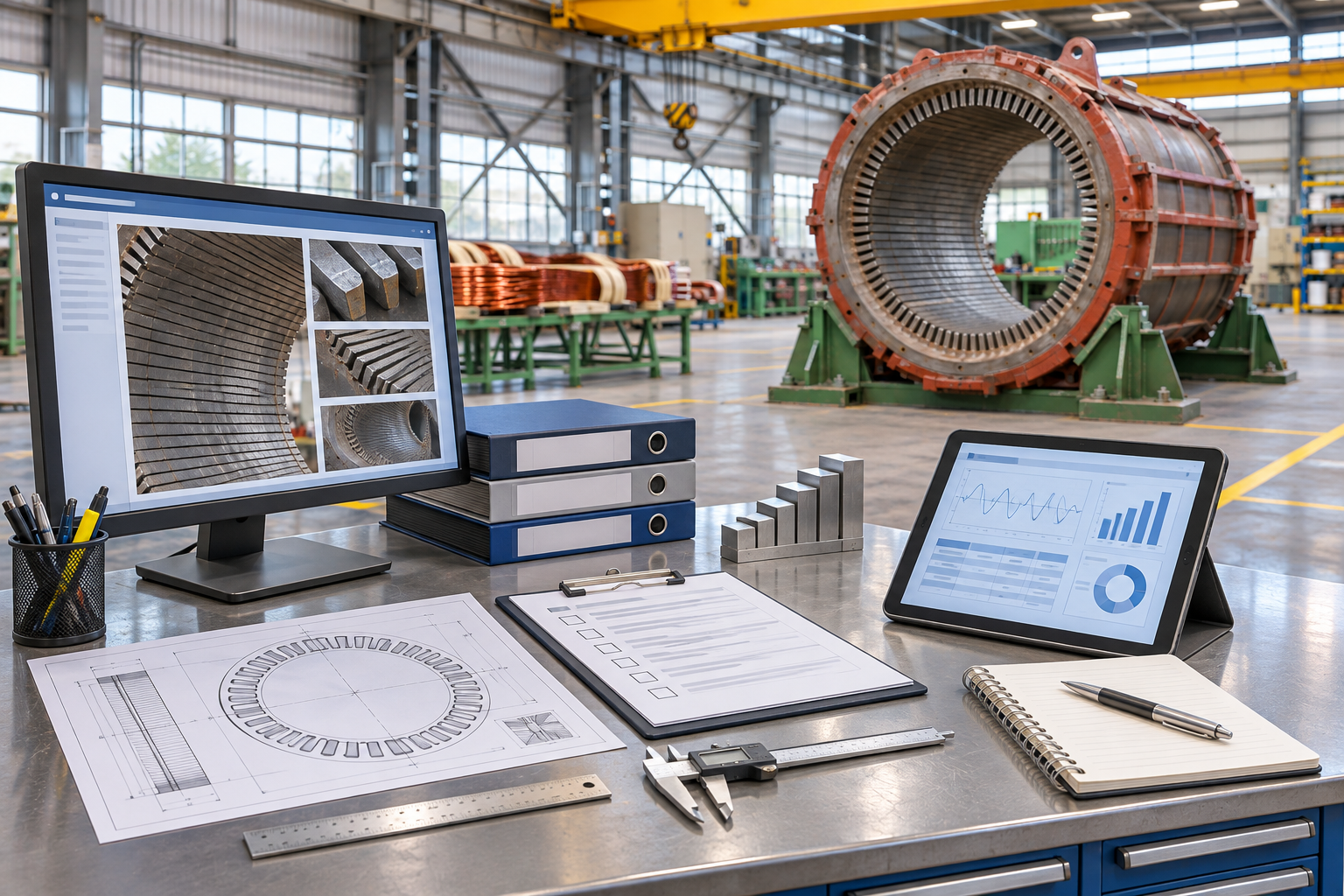
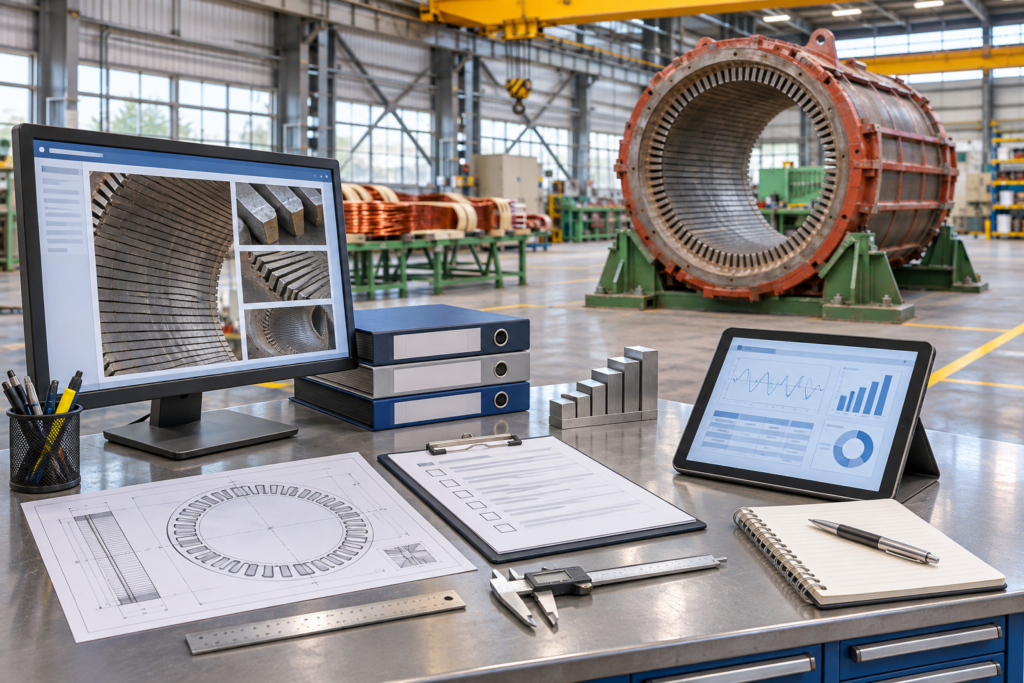
SAMPLE IMAGE 3 — CORE TEST & ENGINEERING REVIEW Suggested visual: electrical engineers reviewing stator-core inspection records and a conceptual core-test report before approving subsequent winding work.
Five Questions to Ask Before Rewinding Begins
1. Has the Core Condition Been Assessed?
Confirm what inspections have been completed and which parts of the core remain inaccessible or unexamined.
2. Was a Relevant Baseline Available?
Review whether an appropriate pre-removal assessment exists and whether its conditions allow meaningful comparison with later findings.
3. Are There Any Unresolved Lamination or Structural Defects?
Identify observed damage, areas of concern and any proposed engineering actions.
4. Are the Slot Surfaces Suitable for the Replacement Winding?
Confirm the condition and geometry relevant to the intended insulation system, coil installation and retaining components.
5. What Evidence Supports Proceeding With Rewinding?
The decision should be supported by the applicable inspection findings, test results and approved engineering disposition.
If important uncertainty remains, the next step may be additional investigation rather than immediate winding installation.
Stator Rewinding Begins With More Than the New Coils
Replacing a damaged winding is only part of restoring a stator assembly.
The underlying core must remain suitable for the new insulation system and the intended operating conditions.
Visual inspection can reveal important physical defects. Specialized core testing may provide additional information about the magnetic structure. Mechanical review can identify conditions that affect winding fit and support.
No single check answers every question.
A responsible engineering decision brings the findings together before the replacement winding is installed.
The objective is not simply to install a new winding. It is to confirm that the stator core provides a suitable foundation for that winding.
Discuss Stator Rewinding Requirements With Kamol Engineering
Kamol Engineering Services Co., Ltd. provides stator rewinding and electrical testing services for industrial electrical machines.
Its published stator rewinding information includes inspection, winding removal and slot preparation as parts of the repair process.
If you are preparing an enquiry for a damaged stator, useful information includes the nameplate, observed damage, failure history, photographs, available drawings and previous inspection records.
Where core damage is suspected, the required assessment and testing scope should be confirmed for the specific machine before work is authorized.
Explore Stator Rewinding Services
Explore Electrical Testing Services
Frequently Asked Questions
Why should the stator core be inspected before rewinding?
The core supports the winding and forms part of the machine’s magnetic circuit. Damage to laminations, slot surfaces or the core structure may affect the suitability of the planned winding repair.
Can a new winding solve stator core damage?
Not by itself. Replacement winding work does not automatically correct damaged laminations, unsuitable slot surfaces or structural defects. The core condition must be evaluated separately.
What is interlaminar insulation damage?
It is deterioration or loss of electrical separation between steel laminations. Depending on the defect and operating conditions, it may permit unwanted currents and additional localized heating.
What is a stator core loss test?
Core-loss testing uses controlled magnetic excitation to assess selected characteristics of the laminated core. The exact method, measured quantities and interpretation depend on the equipment and applicable procedure.
What is the difference between EL CID and a loop test?
EL CID uses relatively low magnetic flux to detect electromagnetic indications associated with interlaminar defects. A loop or ring test uses a different excitation arrangement that can support assessment of losses and localized heating. Their results are not directly interchangeable.
Does EL CID testing detect every core defect?
No. Like other inspection methods, EL CID has limitations. Test results must be interpreted by competent personnel, and further investigation may be appropriate when important uncertainty remains.
Can winding removal damage a stator core?
Yes. Inappropriate thermal or mechanical removal methods can damage laminations, interlaminar insulation, slots or surrounding components. The method should follow the approved repair procedure.
Is an insulation resistance test the same as a stator core test?
No. Conventional winding insulation resistance testing evaluates aspects of the winding insulation system under defined conditions. Core testing addresses characteristics of the magnetic core and interlaminar insulation.
Should core tests be performed before and after winding removal?
Comparison is valuable where the applicable procedure requires it and the tests can be performed under suitable conditions. If a reliable before-removal test is unavailable, that limitation should be documented.
What should engineers review before approving a rewind?
They should review available core inspection findings, relevant test evidence, slot and tooth condition, any required corrective work and the engineering basis for proceeding.
Technical References
EASA — ANSI/EASA AR100-2025: Recommended Practice for the Repair of Rotating Electrical Apparatus
EASA — What Watts, What Pounds? Working With Stator Core Test Results
EASA — Core Testing: A Good Procedure Gone Astray?
Kamol Engineering — Stator Rewinding
Editorial note: This article provides general educational guidance for assessing stator-core condition before rewinding. The exact inspection plan, test method, flux level, acceptance criteria and repair procedure depend on the machine and applicable engineering requirements. The sample images are conceptual placeholders. The official Kamol photograph is illustrative and is not evidence of a particular EL CID, loop-test or core-loss result. No test outcome, defect diagnosis, certification or guaranteed performance is implied.