Electrical, Thermal and Mechanical Considerations
When engineers specify insulation materials for an industrial motor or generator winding, one of the first questions is often about temperature.
Should the winding use Class F or Class H insulation? Would a material with a higher thermal rating provide a better result?
These are reasonable questions, but temperature is only one part of the decision.
A winding insulation system must also withstand electrical stresses, mechanical forces, environmental exposure and the manufacturing processes used to produce the finished winding.
A material may have excellent thermal properties but still be unsuitable for a particular winding geometry, resin system or operating environment.
Effective winding insulation material selection requires an understanding of how electrical, thermal and mechanical properties work together within the complete insulation system.
For critical industrial motors and generators, the objective is not simply to select a material with the highest individual rating. It is to develop a compatible insulation system that meets the actual engineering requirements of the machine.
SAMPLE IMAGE 1
WINDING INSULATION SYSTEM
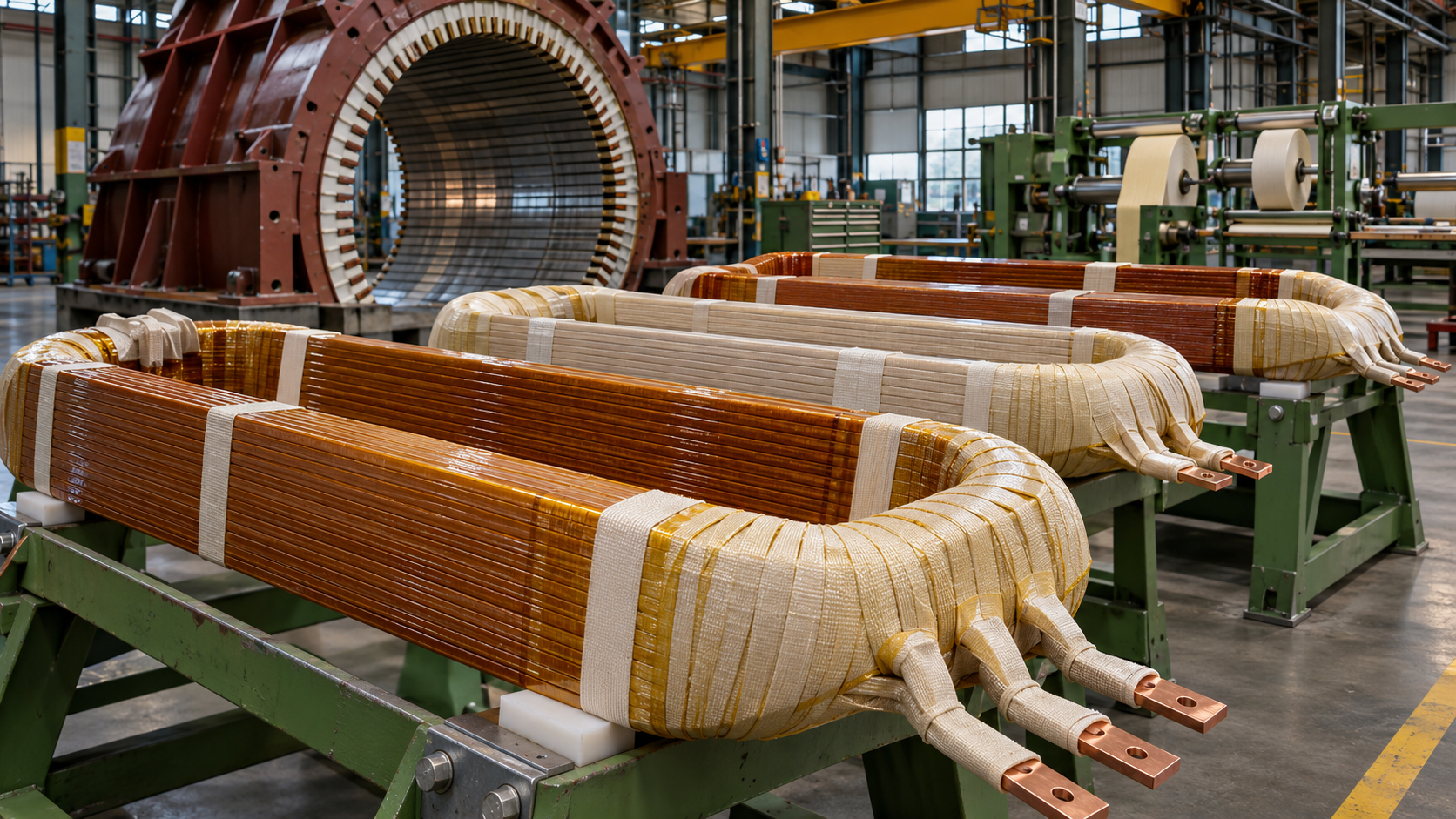
SAMPLE IMAGE 1 — HERO Conceptual illustration of industrial winding coils. Replace with an approved photograph or original illustration of insulated form-wound coils.
What Is a Winding Insulation System?
A winding insulation system is a combination of insulating materials, structural components and processing methods that provide electrical separation and support the operating requirements of an electrical machine.
It is not necessarily a single material wrapped around a copper conductor.
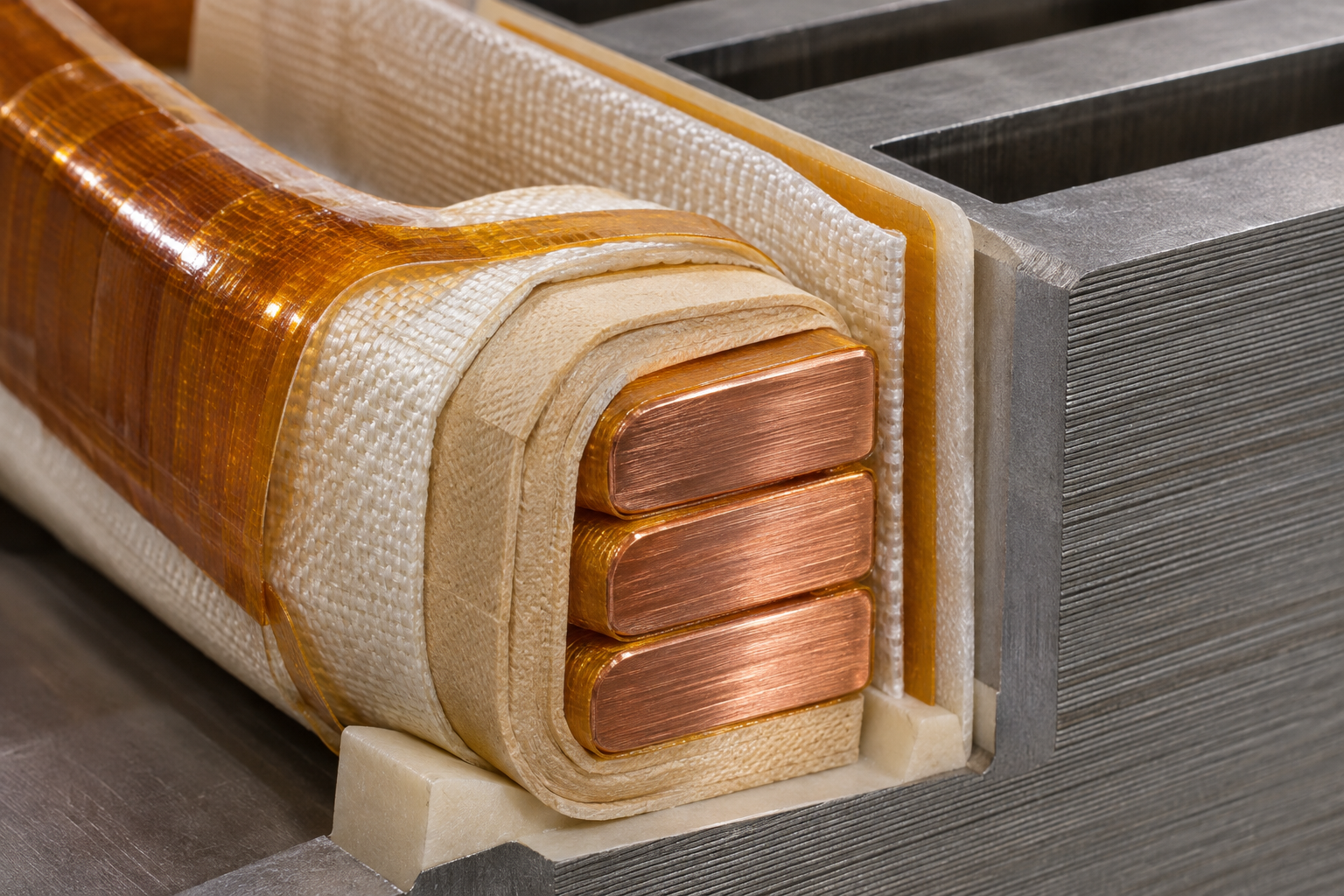
Depending on the winding design, a complete system may include:
- Conductor and turn insulation
- Inter-strand insulation, where applicable
- Phase-to-phase insulation
- Mainwall or groundwall insulation
- Slot liners and insulating separators
- Insulating sleeves for leads and connections
- Resin or varnish treatment
- Mechanical support and binding materials
- Electrical stress-control materials, where required
Each component serves a particular function.
The material selected for turn insulation may perform a different role from the material used to support an end winding or insulate a coil from the grounded stator core.
The suitability of the system depends not only on the individual materials but also on how they interact during manufacturing and operation.
1. Electrical Considerations in Winding Insulation Selection
The primary purpose of electrical insulation is to maintain the required electrical separation between parts of the winding and other machine components.
However, the electrical stresses experienced by insulation are not identical throughout the machine.
Turn-to-Turn Insulation
Turn insulation provides electrical separation between adjacent turns of a winding.
Its requirements depend on the conductor arrangement, winding design and electrical stresses that may develop between turns.
Transient voltages and repetitive voltage impulses can be particularly relevant in certain applications.
Materials and construction methods should therefore be selected for the expected electrical environment rather than the machine nameplate voltage alone.
Phase-to-Phase Insulation
Where different phases are located close to one another, suitable insulation arrangements may be required to maintain the intended electrical separation.
This can be relevant in slot regions, end windings and connection areas, depending on the machine construction.
The required insulation arrangement must follow the winding design.
Mainwall or Groundwall Insulation
Mainwall insulation separates the winding conductors from grounded structures, including the stator core.
In many medium- and high-voltage form-wound machines, mica-based composite insulation systems are used to provide suitable dielectric performance and electrical endurance.
Material choice, insulation thickness, resin properties, processing methods and local electric-field distribution can all influence the performance of the finished system.
Partial Discharge and Electrical Stress Control
In certain medium- and high-voltage winding designs, partial discharge activity and local electric-field concentration are important considerations.
Appropriate insulation materials and stress-control arrangements may be used in selected regions, such as the slot exit of a form-wound stator coil.
Depending on the design, these arrangements may include conductive or semiconductive slot coatings and end-region stress-grading materials.
These components have specific electrical functions and should not be treated as ordinary insulating tapes.
Using a thicker tape or a material with a higher dielectric-strength value does not automatically resolve an electrical stress-control problem.
Variable-Frequency Drive Applications
Motors operated by voltage-source converters can experience electrical stresses that differ from those associated with a conventional sinusoidal supply.
Repetitive voltage impulses, voltage rise time, cable characteristics and the resulting motor-terminal voltage conditions may influence insulation requirements.
For applicable converter-fed machines, the IEC 60034-18-41 and IEC 60034-18-42 standards address different categories of insulation systems and their evaluation.
The appropriate requirements depend on the machine and converter application.
It should not be assumed that any winding insulation system is suitable for every variable-frequency drive installation.
2. Thermal Considerations: More Than Class F or Class H
Electrical machines generate heat during normal operation.
The winding insulation system must retain suitable properties throughout the expected thermal conditions of its intended application.
Temperature, however, should be considered in the context of the machine’s complete thermal design.
Understanding Insulation Thermal Classes
Common thermal-class designations for electrical insulation include Class B, Class F and Class H.
| Thermal Class | Temperature Designation |
|---|---|
| Class B | 130 °C |
| Class F | 155 °C |
| Class H | 180 °C |
These are thermal-class designations. They are not universal permissible motor operating temperatures, winding temperature-rise limits or recommended alarm settings.
As explained by IEC 60085, the thermal evaluation of an individual insulating material must be distinguished from the thermal evaluation of a complete electrical insulation system.
Does Class H Material Automatically Create a Class H Winding?
No.
Using one material with a Class H thermal rating does not automatically establish that the complete winding insulation system qualifies for Class H.
Other insulation components, adhesives, resin systems and their interactions may influence the thermal endurance of the finished system.
The thermal classification must be supported by appropriate evidence for the complete system.
Why Cooling and Heat Transfer Matter
Insulation is necessary for electrical separation, but its thermal properties can also affect the movement of heat away from the conductors.
Inappropriate insulation thickness, unsuitable material combinations or processing defects can influence the winding’s thermal behavior.
The engineering objective is to provide the required dielectric and mechanical characteristics while maintaining a suitable heat-transfer path.
A motor should not be operated at a higher load or temperature merely because a higher thermal-class insulation material has been installed during rewinding.
Any change in operating capability requires a separate engineering assessment of the machine.
3. Mechanical Considerations: Insulation Must Survive Real Forces
Winding insulation does not operate in a purely electrical and thermal environment.
It must also tolerate the mechanical conditions associated with manufacturing, installation and machine operation.
Relevant considerations may include:
- Conductor bending and coil forming
- Insulation abrasion during installation
- Mechanical compression within stator slots
- Electromagnetic forces during operation
- Vibration and repeated mechanical stresses
- Thermal expansion and contraction
- Movement in end-winding regions
- Transient forces during abnormal operating events
A material with suitable dielectric strength may still be inappropriate if it cannot tolerate the forming or installation process.
Similarly, a very rigid material may be unsuitable in a region that requires a controlled degree of flexibility.
The mechanical characteristics of the insulation should match the specific function and geometry of the winding.
Why Insulation Thickness Is Not the Only Answer
Increasing insulation thickness can be appropriate in some designs, but it is not a universal improvement.
A change in insulation build may affect slot fit, conductor space, heat transfer and winding installation.
It may also create interference with adjacent coils or mechanical retaining components.
Any increase or decrease in insulation thickness should therefore be supported by the applicable design requirements.
SAMPLE IMAGE 2
INSULATION MATERIALS
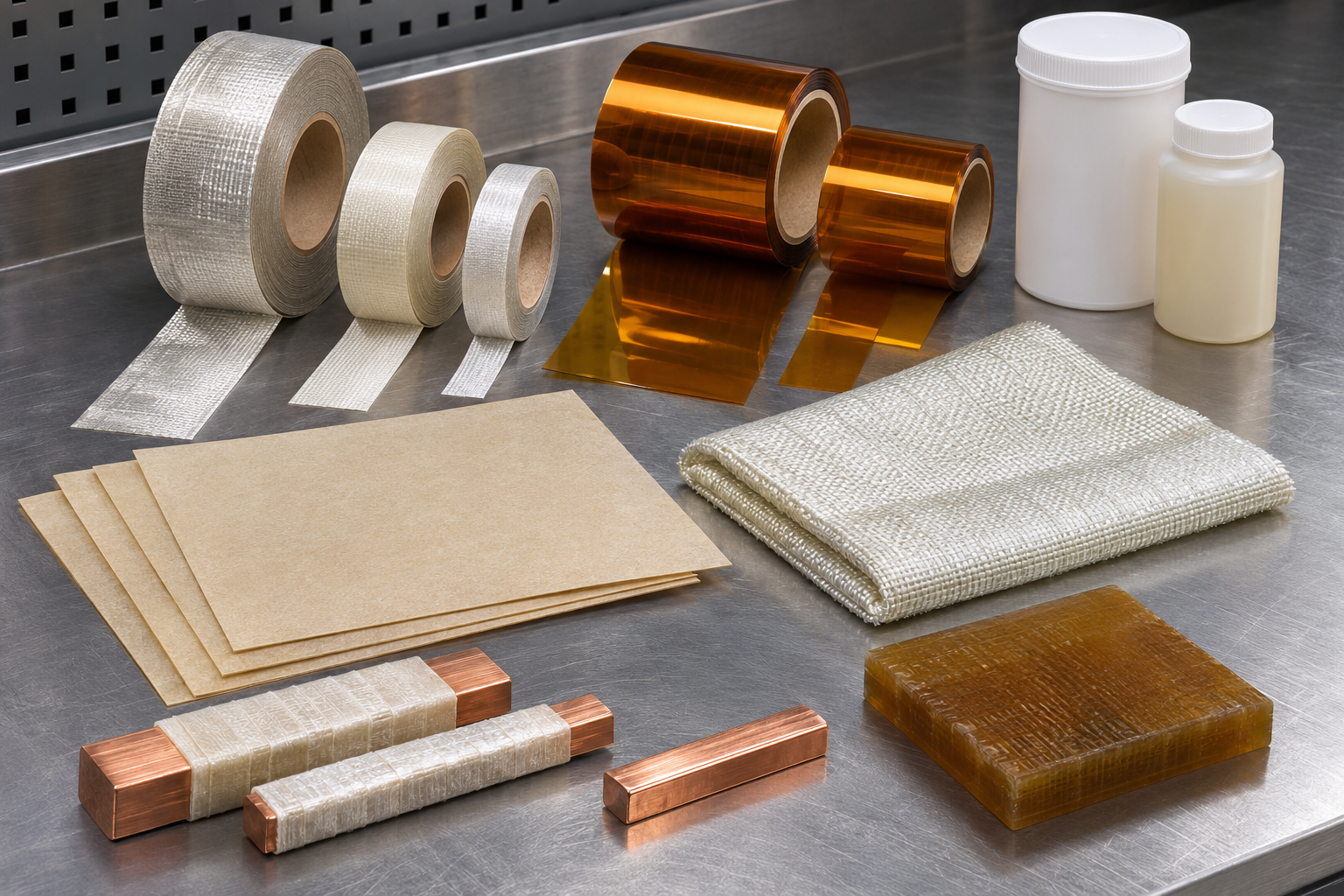
SAMPLE IMAGE 2 — MATERIAL COMPARISON Conceptual material illustration. Replace with an approved photograph showing electrical insulation tapes, films, insulating papers and conductor samples.
Common Winding Insulation Materials and Their Functions
Several material families are used in industrial winding applications.
Each has characteristics that make it suitable for particular functions, but none should be considered a universal replacement for every other insulation material.
1. Mica-Based Insulation Tape
Mica is widely used in insulation systems for many medium- and high-voltage form-wound electrical machines.
Mica-based tapes are often combined with supporting materials, such as glass fabric, and suitable resin systems to create a composite insulation structure.
They can provide valuable electrical-endurance characteristics in appropriate applications.
However, the finished performance depends on the complete tape construction, resin system and manufacturing process.
2. Aramid Insulation Paper
Aramid-based electrical insulation papers, including products sold under the Nomex brand, are used in selected electrical insulation applications.
Potential uses include slot insulation, phase barriers, separators and other insulating components.
The appropriate grade and thickness depend on electrical, mechanical and thermal requirements.
Not every aramid-paper product has the same properties or suitability for a particular resin system.
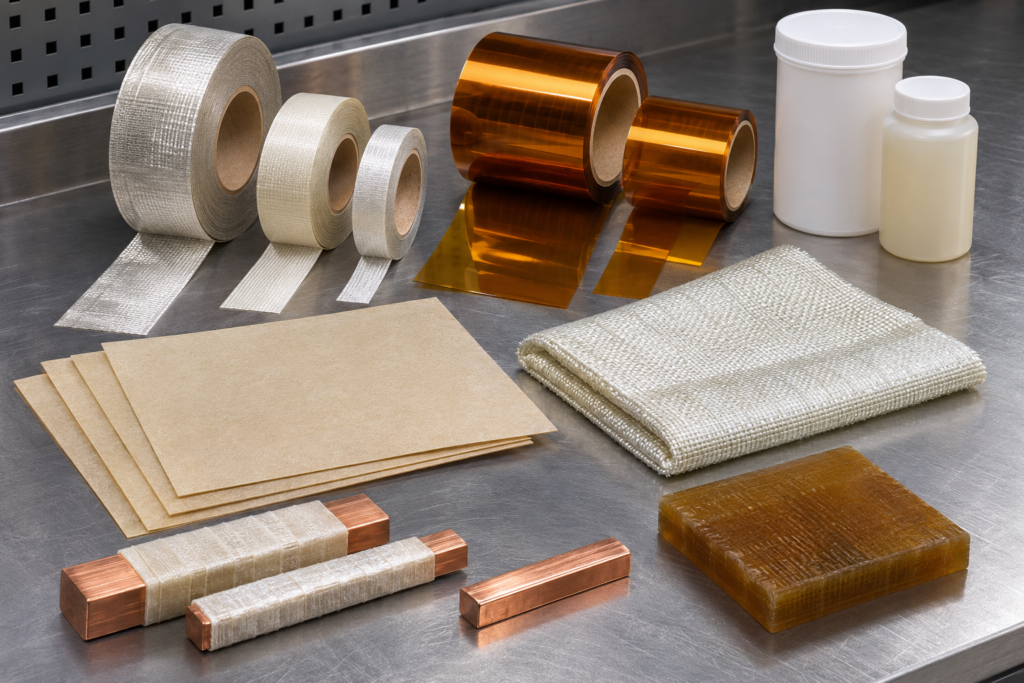
3. Polyimide Film
Polyimide films, including Kapton-branded products, are used in certain applications where electrical insulation, thermal stability and limited available space are important.
Depending on the design, they may be incorporated into conductor insulation, insulating laminates or other specialized components.
Adhesive properties, abrasion resistance, application methods and compatibility with other materials should be considered.
4. Glass Fiber and Glass Fabric
Glass-based materials can provide reinforcement and mechanical support within electrical insulation systems.
Glass fabrics may also act as carrier materials for mica tapes or other insulation composites.
The electrical and mechanical performance of glass-based components depends on their construction, surface treatment and associated resin or binder system.
Glass reinforcement alone should not be assumed to provide all necessary dielectric or partial-discharge endurance characteristics.
5. Epoxy Resin and Electrical Varnish
Resin and varnish systems may be used to impregnate, bind, consolidate or protect winding insulation, depending on the machine design and selected manufacturing process.
Their suitability can depend on:
- Thermal endurance
- Electrical properties
- Viscosity and processing behavior
- Adhesion and mechanical characteristics
- Curing requirements
- Compatibility with solid insulation materials
- Resistance to relevant environmental conditions
Not all epoxy resins or electrical varnishes are interchangeable.
The resin system must be suitable for the intended insulation construction and manufacturing method.
6. Conductor Enamels and Composite Insulation
Insulated winding wire and formed conductors may use enamel coatings, films, tapes, fibers or combinations of materials.
The appropriate construction depends on the winding type, conductor geometry, forming requirements and expected electrical stresses.
The selected insulation must remain suitable after the applicable manufacturing operations have been completed.
Examples of winding material combinations are discussed in the technical review Electrical Machines Winding Technology: Latest Advancements for Transportation Electrification. Actual material selection remains application-specific.
Winding Insulation Material Comparison
The following table illustrates typical functions and engineering considerations associated with several insulation material families.
| Material Family | Typical Function | Selection Considerations |
|---|---|---|
| Mica-based tape | Insulation in selected form-wound coil systems | Electrical endurance, tape construction, resin compatibility and processing |
| Aramid paper | Slot liners, barriers and insulating separators | Material grade, dielectric properties, thickness and mechanical strength |
| Polyimide film | Selected conductor insulation and thin insulating layers | Electrical stress, thermal properties, abrasion and adhesion |
| Glass fiber / fabric | Reinforcement, supporting layers and tape carriers | Mechanical requirements, weave, resin wetting and composite properties |
| Epoxy resin / varnish | Impregnation, bonding and winding consolidation | Chemical compatibility, curing procedure and finished system properties |
| Conductor enamel | Electrical separation of winding wire or selected conductors | Electrical stress, forming capability, thermal endurance and compatibility |
| Stress-control materials | Electric-field management in applicable winding regions | Electrical characteristics, geometry, interfaces and approved design |
This comparison is an educational guide. It is not an approved material specification, a ranking of insulation quality or a substitute for engineering qualification.
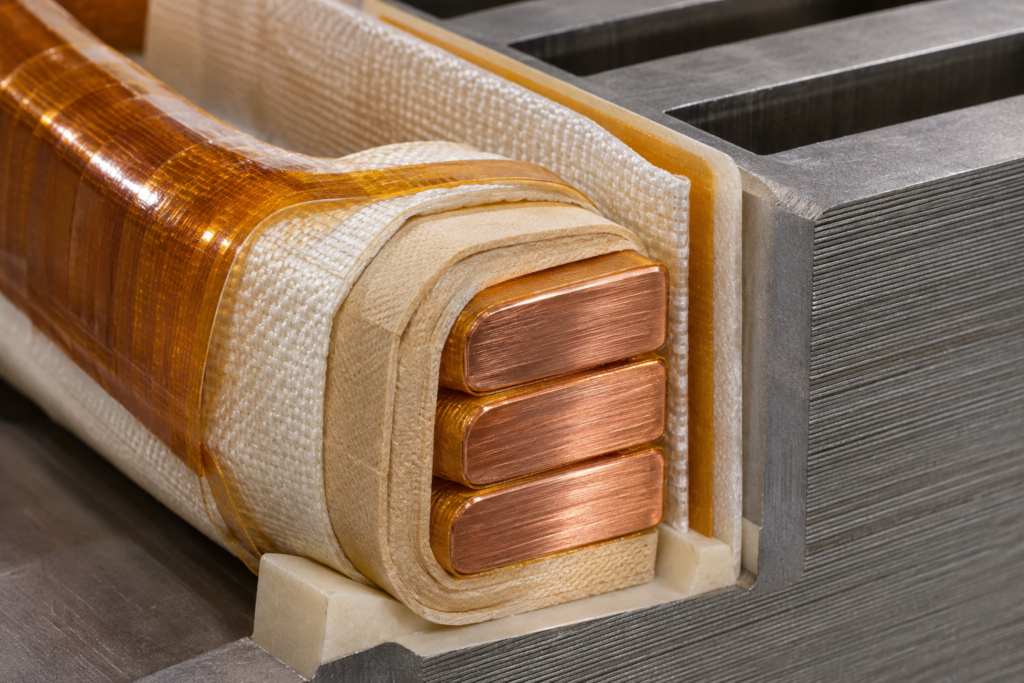
4. Evaluate Material Compatibility Within the Complete System
One of the most important questions in insulation selection is not simply whether a material is suitable on its own.
It is whether the material is suitable when combined with the other components of the winding.
For example, a proposed insulation tape may have acceptable thermal and electrical properties, but its interaction with a particular impregnating resin, adhesive or curing process may still require evaluation.
Changing one component can influence the performance of a previously established insulation system.
Can Materials With the Same Thermal Class Be Substituted?
Not automatically.
Two materials with similar thermal designations may differ in dielectric endurance, mechanical flexibility, thickness, bonding characteristics or chemical compatibility.
Replacing a material solely because it has the same nominal temperature rating may introduce an unintended change to the finished winding.
Where substitution is necessary, the proposed change should be evaluated through the applicable engineering and qualification process.
The appropriate evidence depends on the original insulation system, proposed material change and intended machine application.
5. Match the Materials to the Manufacturing Process
Insulation materials must be selected with the intended manufacturing route in mind.
Different types of windings and insulation systems can require different processing methods.
Vacuum Pressure Impregnation (VPI)
VPI uses vacuum and pressure as part of an impregnation process intended to introduce a suitable resin into accessible spaces within the insulation structure.
The materials must be compatible with the selected resin and process requirements.
Resin penetration, curing and finished insulation properties depend on the complete system and how the process is controlled.
Using VPI does not, by itself, guarantee a completely void-free insulation system.
Resin-Rich Insulation Systems
Some form-wound coil systems use tapes containing resin as part of their insulation construction.
Controlled consolidation and curing may be used to develop the intended finished properties.
Resin-rich and VPI-based manufacturing routes have different material and processing requirements.
Neither process should be considered universally superior without evaluating the actual winding design and its requirements.
Curing and Thermal Processing
Temperature, processing duration and other applicable parameters should follow approved manufacturing instructions and relevant material specifications.
A curing schedule suitable for one resin system may not be appropriate for another.
The material selection and manufacturing process should therefore be considered together from the beginning.
6. Consider the Actual Operating Environment
Industrial motors and generators may operate in environments that introduce additional insulation requirements.
Depending on the installation, relevant conditions may include:
- High ambient temperatures
- Humidity and condensation
- Dust and industrial contamination
- Exposure to oils or process chemicals
- Frequent thermal cycling
- Mechanical vibration
- Special cooling arrangements
- Repetitive starting or variable-speed operation
The insulation system should be evaluated for the conditions that are relevant to the actual machine.
For equipment used in hazardous areas or other specialized applications, additional design, repair, certification or regulatory requirements may apply.
A general change to insulation materials must not be assumed acceptable for equipment subject to such requirements.
SAMPLE IMAGE 3
INSULATION SYSTEM COMPATIBILITY
CONCEPTUAL ONLY — NOT A DESIGN DRAWING
SAMPLE IMAGE 3 — INSULATION STRUCTURE Simplified conceptual illustration of conductor insulation and surrounding insulation layers. Not to scale and not representative of a specific winding design.
A Six-Step Framework for Selecting Winding Insulation
For a new coil manufacturing or rewinding project, the following framework can help organize the engineering review.
- Identify the machine and application. Confirm the machine type, electrical ratings, winding construction, operating duty, cooling arrangement and relevant environmental conditions.
- Review the original insulation system. Collect available drawings, material specifications, manufacturing records and evidence from previous repair work.
- Define the required material functions. Identify which components provide turn insulation, mainwall insulation, mechanical protection, separation, reinforcement or stress control.
- Evaluate material properties and compatibility. Review electrical, thermal, mechanical and chemical characteristics together rather than considering a single material rating.
- Confirm manufacturing suitability. Ensure that the proposed materials are compatible with the specified winding, forming, impregnation, consolidation and curing methods.
- Establish the evaluation and approval requirements. Determine the relevant design verification, qualification evidence, inspection methods and acceptance criteria before production.
The objective is to identify and resolve material-related uncertainties before they become manufacturing or installation problems.
Insulation-System Qualification Is Different From Routine Testing
Testing a completed coil or winding against specified acceptance requirements is not the same as qualifying an insulation system.
Routine tests may provide evidence about selected characteristics of an individual manufactured or repaired winding.
Insulation-system qualification addresses the suitability of a defined system under the relevant evaluation requirements.
Depending on the design and application, the IEC 60034-18 series provides guidance and procedures for the functional evaluation of rotating-machine insulation systems.
For example, IEC 60034-18-31 addresses thermal evaluation of applicable form-wound insulation systems, while IEC 60034-18-32 addresses electrical-endurance qualification within its defined scope.
A satisfactory insulation resistance or dielectric withstand test does not, by itself, establish the thermal classification or long-term endurance of a newly proposed insulation system.
The required qualification and production verification should be identified separately for the specific project.
Common Mistakes in Winding Insulation Selection
- Selecting materials based only on their thermal-class designation.
- Assuming insulation materials with similar ratings are interchangeable.
- Increasing insulation thickness without reviewing slot fit and thermal performance.
- Changing resin systems without evaluating material compatibility.
- Using a material suitable for one winding region in another region without reviewing its function.
- Ignoring converter-related electrical stresses in applicable motor installations.
- Assuming that a successful final electrical test establishes complete insulation-system qualification.
These mistakes share a common feature: they evaluate individual properties or activities without considering the complete winding system.
What Should Customers Ask Before Approving an Insulation System?
When discussing a replacement coil or rewinding project with a manufacturer or repair provider, useful questions include:
- What insulation system is proposed for this machine?
- Which materials perform the different insulation functions?
- What evidence supports the proposed thermal classification?
- Are the materials compatible with the specified manufacturing process?
- Does the design account for the electrical stresses of the actual application?
- Have slot fit and mechanical requirements been reviewed?
- Are any proposed material substitutions subject to engineering approval?
- Which qualification evidence, inspections and test records are relevant?
Clear answers can help establish a more focused technical discussion before manufacturing begins.
The Best Insulation Material Is the One That Fits the System
A higher temperature rating does not automatically make one material better for every winding application.
Likewise, high dielectric strength alone does not establish that a material can survive the mechanical, environmental and manufacturing demands of a particular machine.
For industrial motors and generators, insulation selection must bring these requirements together.
The electrical properties must suit the operating stresses. The thermal characteristics must support the intended machine design. The mechanical behavior must be compatible with manufacturing, installation and service.
And the individual materials must work together as a complete insulation system.
Reliable winding insulation begins with engineering compatibility, not simply a higher material specification.
Discuss Winding Insulation Requirements With Kamol Engineering
Kamol Engineering Services Co., Ltd. provides made-to-order coil manufacturing and stator rewinding services for industrial electrical machines.
Its published coil manufacturing information identifies configurable insulation materials and systems, including mica-glass, aramid-based materials, polyimide and resin-related process options.
The appropriate configuration depends on the machine design and agreed project specifications.
If you are planning a replacement coil manufacturing or motor rewinding project, useful starting information includes:
- Machine nameplate and application
- Available original winding drawings
- Existing insulation-system specifications
- Coil geometry and slot dimensions
- Operating and environmental requirements
- Proposed repair or manufacturing scope
- Applicable qualification and documentation requirements
Share the available technical information so that the material and manufacturing requirements can be discussed in the context of your application.
Explore Coil Manufacturing Explore Stator Rewinding Contact Kamol Engineering
Frequently Asked Questions
What materials are commonly used for motor winding insulation?
Depending on the winding design, common material families include conductor enamel, mica-based tapes, aramid paper, polyimide films, glass-based materials, epoxy resins and electrical varnishes. Each material must be selected for its specific function within the insulation system.
What is the best insulation material for a high-voltage motor?
There is no universal best material. Mica-based composite systems are widely used in many high-voltage form-wound applications, but the appropriate selection depends on electrical stresses, winding design, thermal requirements, mechanical conditions and manufacturing compatibility.
What is the difference between Class F and Class H insulation?
Class F and Class H correspond to thermal-class designations of 155 degrees Celsius and 180 degrees Celsius, respectively. These designations should not be interpreted as universal motor operating-temperature limits. The qualification of the complete insulation system and the machine’s permitted operating conditions must be considered.
Can Class H insulation replace Class F insulation?
Potentially, but not automatically. The proposed materials and system must be evaluated for compatibility, electrical performance, mechanical characteristics, winding geometry and manufacturing requirements. A higher thermal class alone does not establish suitability.
Does thicker winding insulation improve motor reliability?
Not necessarily. Additional insulation thickness may influence electrical performance, but it can also affect slot fit, conductor space and heat transfer. Insulation build should follow the approved winding design.
Why is mica used in high-voltage motor and generator insulation?
Mica-based materials can provide useful dielectric and electrical-endurance characteristics in appropriate insulation systems. They are commonly used in composite structures with supporting materials and compatible resin systems.
Is VPI necessary for every motor winding?
No. VPI is one possible insulation treatment process. The appropriate manufacturing route depends on the winding design, insulation system and approved project requirements.
Can insulation materials be changed during rewinding?
Material changes may be possible, but they should be evaluated against the original design, proposed insulation system, manufacturing process and applicable engineering requirements. Similar material ratings do not automatically establish interchangeability.
Do VFD-driven motors require special winding insulation?
Converter-fed motors can experience repetitive impulse voltages and other electrical stresses that influence insulation requirements. The need for a particular insulation system depends on the motor, converter, installation and applicable evaluation criteria.
Does passing a high-voltage test prove that the insulation system is fully qualified?
No. A withstand test evaluates insulation under specified test conditions. It does not independently establish the complete insulation system’s thermal classification, electrical endurance or suitability for every operating environment.
Technical note: This article provides general educational guidance on winding insulation material selection. Actual material grades, insulation thicknesses, thermal classification, manufacturing parameters and qualification requirements must be established for the specific machine and approved design. The illustrations are conceptual placeholders, not actual Kamol project photographs or manufacturing drawings. Reference to technical standards does not imply company certification or project-specific compliance.